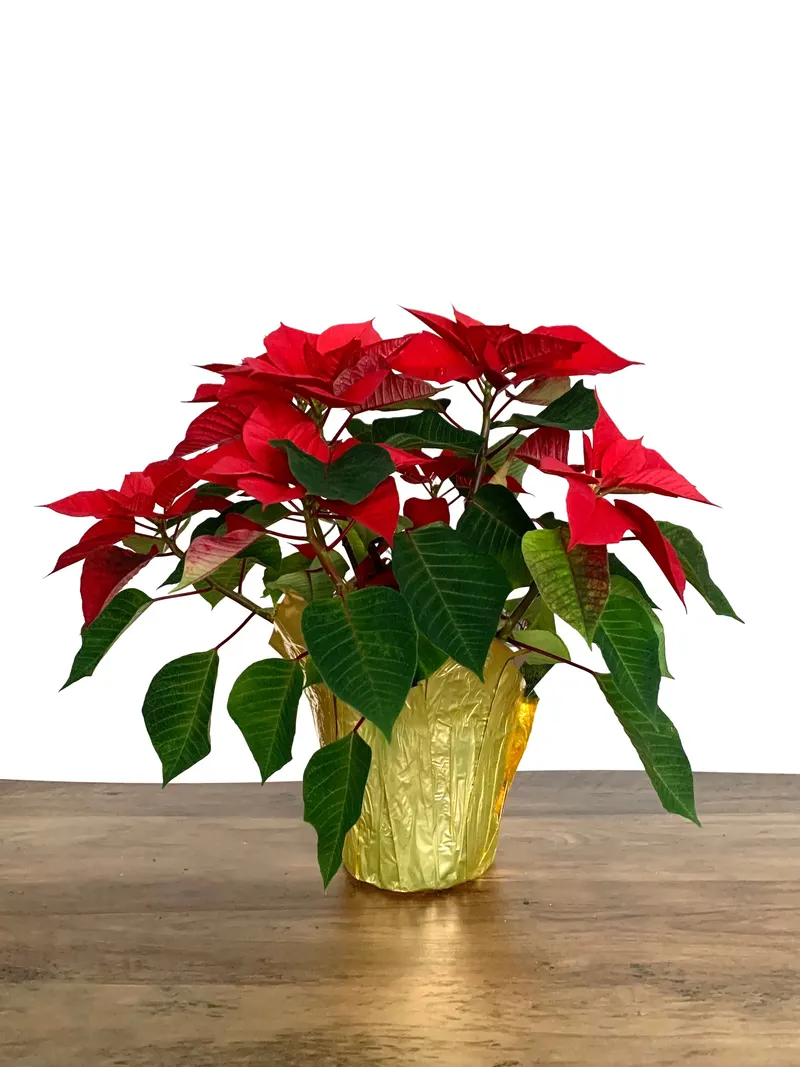
What it does for you
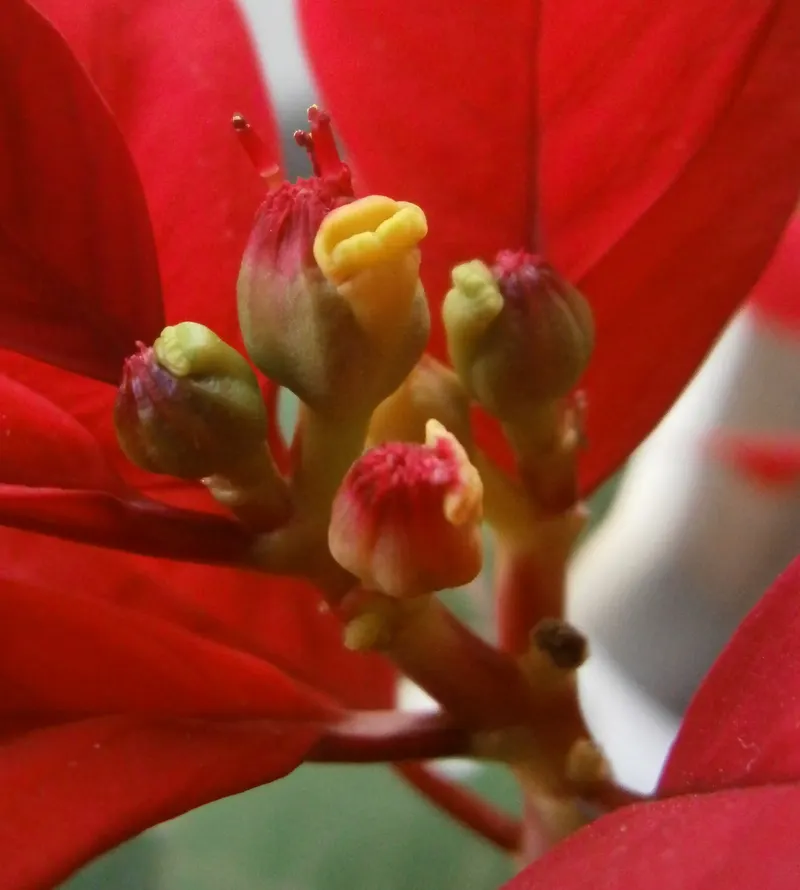
The poinsettia brings strong colour into winter – red, pink or white1. The bright part isn't flowers, though, but bracts; the real flowers are the small yellow cyathia in the middle2,3. It doesn't have to be thrown away: with care and long nights, it colours up again the next winter2.
Origin & history
In the wild it grows from Mexico to Guatemala in seasonally dry tropical forests – as a shrub several metres tall7,2.
The Aztecs called it Cuetlaxochitl8. In Mexico it later became the "Flor de Nochebuena", the flower of the Holy Night9. In 1828 the US envoy Joel R. Poinsett brought it to the USA2 – hence the name poinsettia.
Caution
The white milky sap can irritate skin and mucous membranes and trigger allergies1,5. NC State warns of mild to severe contact dermatitis and, if it gets into the eye, lasting damage to the cornea1. The Bonn poison centre notes that the strongly irritant diterpenes were found only in the wild form and could not be detected in cultivated varieties5. As the sources differ, treat the sap as an irritant: wear gloves and keep it out of your eyes. Eaten leaves cause stomach ache, nausea and vomiting, very rarely drowsiness and dizziness5,2. In cats and dogs it irritates the mouth and stomach, and they sometimes vomit6; isolated severe cases have been described5.
Care
Light. Bright, but without harsh sun10,3; in winter it tolerates full light11.
Water. Water as soon as the surface is dry – neither let it dry out nor keep it wet10. Open the wrapping at the bottom so water can drain3.
Temperature & humidity. An even 16–21 °C, away from radiators and draughts, not by a cold window at night10. Below 10 °C it drops leaves2; while it's coloured, keep it at 13 °C or more11. Don't buy one from a cold display outside the shop10.
Soil, pot & repotting. Peat-free, loam-based soil with some bark11. Cut it back to about 20 cm in early or mid-spring, and move it into a pot 5–10 cm (2–4 in) bigger in early summer2.
Feeding. Don't feed while it's coloured3; after that, every two to three weeks from spring to early autumn2.
Extras
How to get it to colour up again: it's a short-day plant. From mid-autumn, keep it completely dark for 14 hours every night for eight to ten weeks – under a cardboard box, say – and bright during the day2,3. Even lamplight in the evening prevents the colouring3.

Symptoms & help
| too little | too much | |||
|---|---|---|---|---|
| Water | Leaves wilt and drop. → Water thoroughly as soon as the surface is dry, and never let the soil dry out completely. | Leaves drop, the roots and stems rot. → Only water again once the surface is dry; don't leave water standing in the wrapping or cachepot. | ||
| Light | Leaves yellow and drop, the shoots grow long and thin. → Move it to a bright spot by the window, but out of direct sun. | In autumn the bracts stay green because lamplight in the evening disrupts the long nights. → From mid-autumn, keep it completely dark for 14 hours every night for eight to ten weeks. | ||
| Fertiliser | Weak growth in the growing season. → From early spring to early autumn, feed with liquid fertiliser every two to three weeks. | |||
| Warmth | Sudden leaf drop, often right after buying or after a draught at the window. → Keep it at an even 16–21 °C, away from draughts and not by a cold window at night. | Leaves and bracts drop when it stands by or above a radiator. → Move it to an evenly warm, bright spot at a distance from the radiator. |
Take it with you
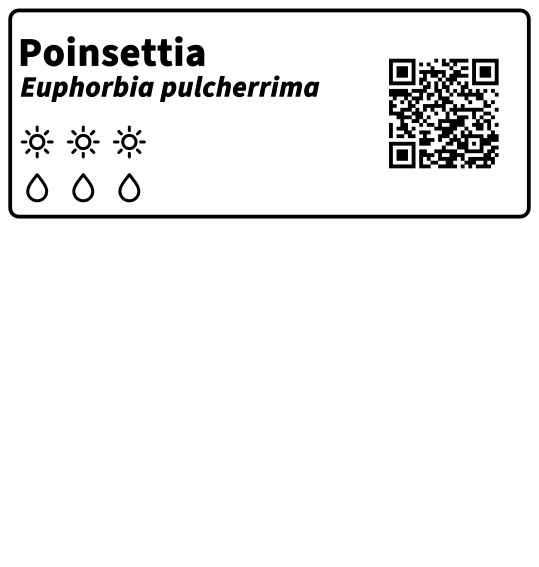
- Plant cardFront and back in A6 landscape – print it and keep it next to the pot
- PDF ↓
Notes on the files: Print & engrave
Licence and attribution for the plant labels: Readme (TXT)
Sources
- North Carolina State University Extension: Euphorbia pulcherrima. North Carolina Extension Gardener Plant Toolbox. https://plants.ces.ncsu.edu/plants/euphorbia-pulcherrima/ (accessed 14 October 2026)
- Polomski, R. F. & Doubrava, N. (2015): Poinsettia. Clemson Cooperative Extension, Home & Garden Information Center, Factsheet. https://hgic.clemson.edu/factsheet/poinsettia/ (accessed 14 October 2026)
- Ricigliano, D. (2023): Poinsettias. University of Maryland Extension, Home & Garden Information Center. https://extension.umd.edu/resource/poinsettias (accessed 14 October 2026)
- Krenzelok, E. P., Jacobsen, T. D. & Aronis, J. M. (1996): Poinsettia exposures have good outcomes … just as we thought. American Journal of Emergency Medicine 14(7), 671–674. doi:10.1016/S0735-6757(96)90086-8
- Informationszentrale gegen Vergiftungen Bonn: Weihnachtsstern (Euphorbia pulcherrima). Giftzentrale Bonn – Pflanzen. https://gizbonn.de/giftzentrale-bonn/pflanzen/weihnachtsstern (accessed 14 October 2026)
- ASPCA Animal Poison Control Center: Poinsettia (Euphorbia pulcherrima). Toxic and Non-Toxic Plant List. https://www.aspca.org/pet-care/animal-poison-control/toxic-and-non-toxic-plants/poinsettia (accessed 14 October 2026)
- Royal Botanic Gardens, Kew: Euphorbia pulcherrima Willd. ex Klotzsch. Plants of the World Online. https://powo.science.kew.org/taxon/urn:lsid:ipni.org:names:30176564-2 (accessed 14 October 2026)
- University of Illinois Extension: Poinsettia history. Poinsettias – Houseplants. https://extension.illinois.edu/houseplants/history (accessed 14 October 2026)
- Kerr, A. (2024): 5 Fun Facts About Poinsettias. NC State University, College of Agriculture and Life Sciences – News. https://cals.ncsu.edu/news/5-fun-facts-about-poinsettias/ (accessed 14 October 2026)
- Royal Horticultural Society: Poinsettias. RHS Plant Guide. https://www.rhs.org.uk/plants/euphorbia/poinsettia (accessed 14 October 2026)
- Royal Horticultural Society: Euphorbia pulcherrima – poinsettia. RHS Find a Plant. https://www.rhs.org.uk/plants/88057/euphorbia-pulcherrima/details (accessed 14 October 2026)
- Royal Horticultural Society: How to take cuttings from houseplants. RHS Growing Guide. https://www.rhs.org.uk/plants/types/houseplants/how-to-take-cuttings-from-houseplants (accessed 14 October 2026)
- DelPrince, J. M. & Perry, J. H. (2021): Care & Selection of Indoor Plants. Mississippi State University Extension, Publication 1012. https://extension.msstate.edu/publications/care-selection-indoor-plants (accessed 11 October 2026)