Most entries in the fact sheet are scales from 1 to 5: the more symbols are filled in, the more of it the plant needs. For light, the strong symbol shows the ideal spot and the pale ones next to it what the plant can still put up with. All entries are rules of thumb – your plant itself is the best guide to whether it's doing well. What it's trying to tell you with yellow, brown or droopy leaves is in every portrait under "Symptoms & help".
Care
- very easy Forgives mistakes and forgotten watering – perfect for getting started.
- easy Does fine with normal care, as long as the spot is right.
- moderate Quickly shows watering and placement mistakes – a little attention pays off.
- demanding Needs just the right conditions, such as lots of light or high humidity.
- for experts Usually only thrives long-term with experience or equipment like a grow light or a glass cabinet.
The care level also sets the order in this booklet: it starts with the indestructible ones and ends with the divas. If you're just getting started, pick your first housemates from the front.
Light
- shade A few steps from a window without direct sun, 1–3 m from a window with morning or evening sun, or 4–6 m from a window with midday sun.
- partial shade Right at a window without direct sun, just under 1 m beside a window with morning or evening sun, or 1–3 m from a window with midday sun.
- bright, no midday sun A bright spot without direct sun – say behind a sheer curtain at a window with morning or evening sun, or 1–2 m from a window with midday sun.
- bright with some sun Right at a window with morning or evening sun, or up to 1.5 m from a window with midday sun.
- full sun Right at a window with midday sun, as much sun as possible.
Light can be one of the most limiting factors for houseplants. Outdoors it is many times brighter than indoors1. And with every step away from the window it quickly gets darker: just a few steps away, only a tenth of the light may arrive2. Curtains, blinds, balconies and canopies swallow even more light2.
The distances in the table are rules of thumb from an overview by the University of Illinois, converted from feet to metres and rounded1. The overview names windows by compass direction, the table by their sun: a window with midday sun faces south in the northern hemisphere and north in the southern hemisphere and gets the most sun; one facing the other way gets hardly any direct sun. In winter every plant can stand as bright as possible. In summer, though, sensitive plants can get sunburn behind glass3 – then move them back a little.
Water
- very little Only water once the soil has dried out completely – roughly every 2–4 weeks in summer, less often in winter.
- little Water when the soil is dry a finger deep – roughly every 1–2 weeks in summer.
- moderate Water when the top 2–3 cm are dry – roughly once a week in summer.
- plenty Water as soon as the surface starts to dry – often several times a week in summer.
- always moist The soil must never dry out, but mustn't stand in water either – check often.
The times in the table are rough guidelines for a bright, normally heated room. But never water by the calendar – check first whether the plant really needs water3. The easiest way is the finger test: push your finger into the soil up to the second knuckle. If soil sticks to your finger, there's still enough water2. With a bit of practice you can also tell by the weight: dry pots are lighter3.
How to water properly. Water thoroughly until water runs out at the bottom, then tip away the water from the saucer or cachepot3. A pot without a drainage hole almost inevitably leads to waterlogging – and then the roots rot. Use room-temperature water, especially in winter3.
In winter most plants need less water, because they hardly grow in low light. In a cool room many manage one to two weeks without watering. If the plant stands somewhere warm above the radiator, though, the soil still dries out quickly3.
Humidity
- dry air is fine Copes well even with dry, heated air in winter.
- low Normal room air is enough – just don't put it right above a radiator.
- medium In winter, grateful for neighbouring plants or a tray of damp gravel.
- high Needs help – a gravel tray, a group of plants, a steamy bathroom or a humidifier.
- very high Only thrives long-term in a glass cabinet, a terrarium or with a humidifier.
Heated rooms are often surprisingly dry: 10 to 30 percent relative humidity is not unusual, while many tropical plants are used to 70 to 90 percent in their homeland2. A small hygrometer shows you what it's like at your place.
This is how you help plants that love humidity3,2:
- Gravel tray: stand the pot on a tray of gravel or expanded clay, and only add enough water that the bottom of the pot doesn't sit in it.
- Grouping: several plants side by side raise the humidity between them.
- Humidifier: the most effective solution for very demanding plants.
- Bathroom: many tropical plants are best off in a steamy bathroom.
Misting can help if you do it often, but it can encourage leaf diseases in some plants3,2.
Height
- small (up to 30 cm) Fits on any windowsill or shelf.
- medium-low (30–60 cm) For a windowsill, shelf or sideboard.
- medium (60 cm–1 m) Best on the floor or on a stool.
- tall (1–2 m) A floor plant – needs room upwards and to the sides.
- very tall (over 2 m) Grows up to the ceiling over time unless you cut it back.
The height in the fact sheet is the size a plant typically reaches indoors after a few years. For hanging plants it shows the shoot length instead, that is, how long the trailing stems get. Next to the symbols is the approximate value the level comes from. After that come the width – how much room the plant needs to the sides – and the growth habit: upright, bushy, as a rosette, climbing or trailing. If "est." comes before the width, no source gives a value for the houseplant; we derived it from the size outdoors or from the leaf size.
Growth
- very slow Barely changes over the years – rarely needs repotting, almost never pruning.
- slow Grows at a leisurely pace, new leaves tend to come one at a time.
- medium Grows visibly during the season without getting out of hand.
- fast Puts on a lot during the growing season – repot more often, prune now and then.
- very fast Grows at a racing pace in good light – pruning and a support are part of the care.
Growth shows how fast a plant puts on size in good conditions – and so also how often you'll need to repot or prune. The levels are rough classifications, not measurements.
Temperature
“ideal” is the comfort range; below the minimum temperature the plant can be damaged – watch out at cold windows and in cold draughts in winter.
Most houseplants are happy at a perfectly normal room temperature2. Take care in winter: when it's freezing outside, leaves shouldn't touch the windowpane2. Keep plants out of cold draughts, and don't leave them behind a drawn curtain at night – it can get very cold there3.
Soil
- houseplant soil (peat-free)
- Loose, lightly pre-fertilised all-round soil for most foliage plants. Ideally peat-free.
- cactus and succulent soil
- Very free-draining, with lots of sand, grit, pumice or lava rock. Holds little water and dries quickly – for cacti and succulents. To mix your own: houseplant soil with a third sand or grit.
- standard potting compost
- A gardener's standard compost with some clay. Heavier and more stable than ordinary houseplant soil, holds water and nutrients well – for large, top-heavy plants.
- mineral substrate (e.g. expanded clay, pumice)
- No humus at all, e.g. expanded clay, pumice or lava rock. Doesn't rot and hardly compacts; nutrients come only from the fertiliser.
- orchid substrate
- Coarse pieces of bark, very airy. For plants that grow on trees in the wild.
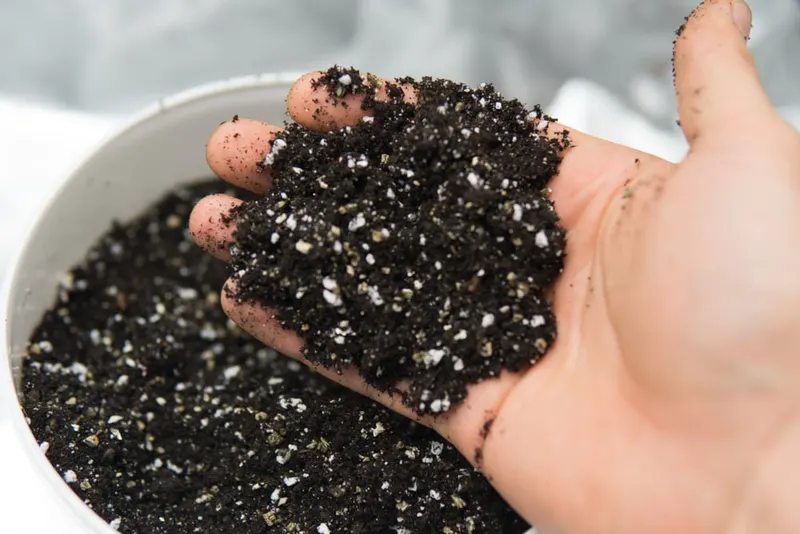

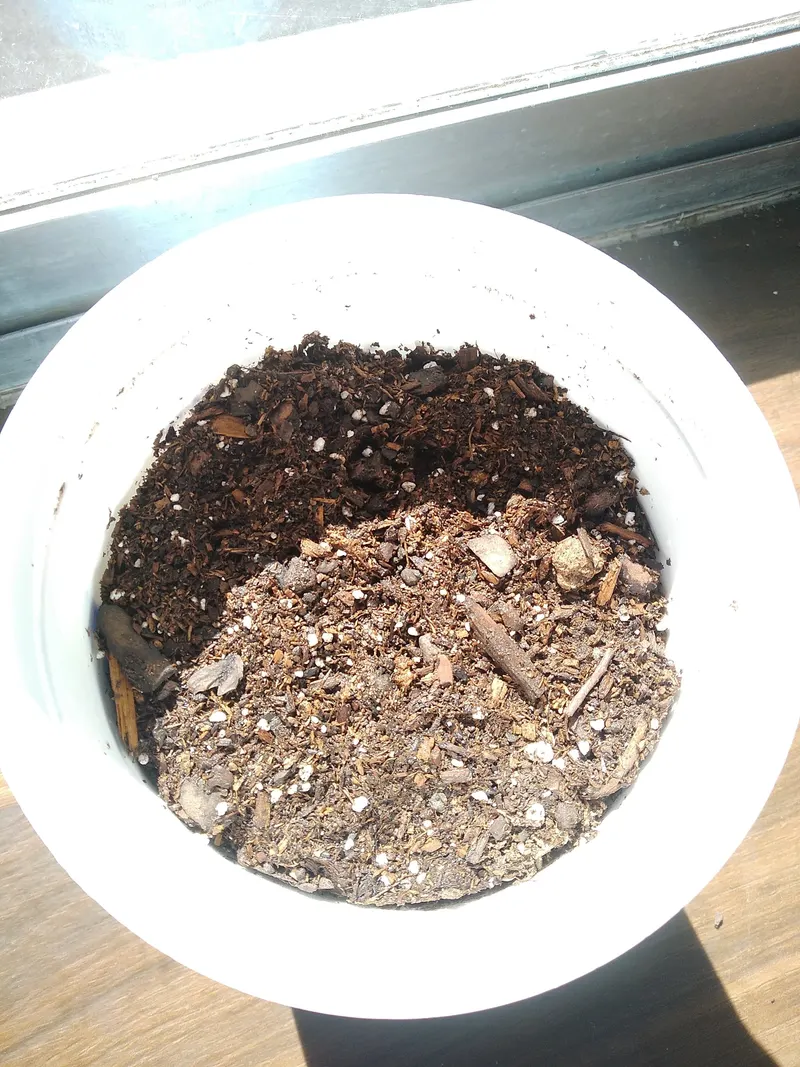

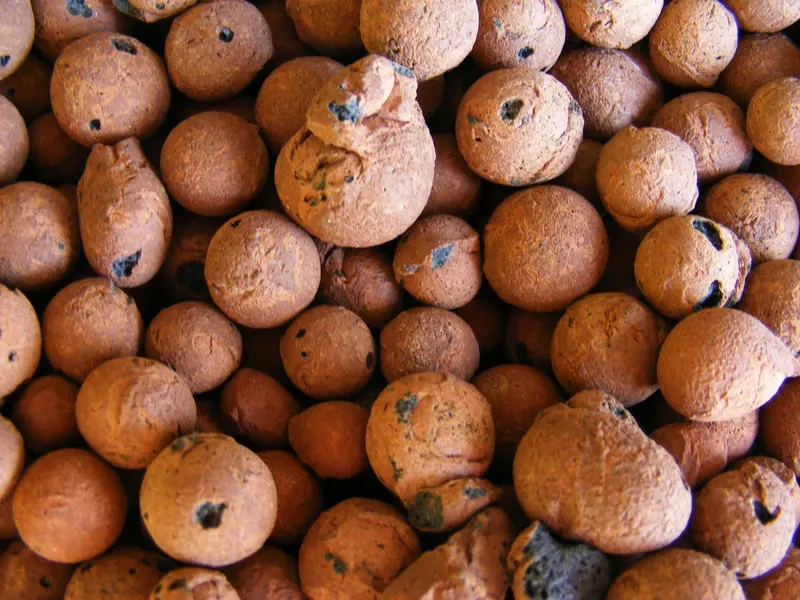

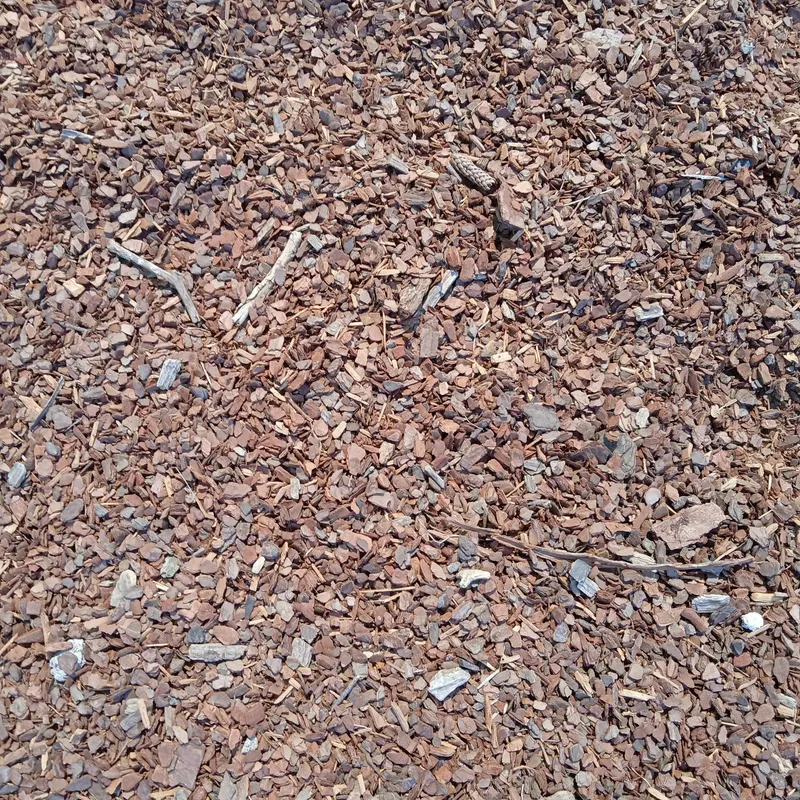

Soil is more than dirt in a pot: it holds water and nutrients and still has to let enough air reach the roots. Ready-made soils are made of organic parts such as compost, bark or wood fibre and mineral ones such as sand, perlite or clay2. Sand and perlite improve drainage2. Plants that need extra drainage benefit from grit or sharp sand (horticultural, not builders' sand) mixed into the soil3. Ideally buy peat-free soil, as the RHS advises4.
Feeding
How often to feed during the growing season – liquid fertiliser in the watering can, never onto dry soil.
During the growing season, roughly from spring to autumn, plants use up nutrients, which you top up with fertiliser. The easiest is liquid fertiliser that you add to the watering can. Foliage plants do well with a fertiliser high in nitrogen; flowering plants need more phosphorus and potassium. In winter there isn't enough light to use fertiliser – then feed at most once a month or not at all3.
Never feed onto dry soil, it can burn the roots3. And better too little than too much: white crusts on the soil, brown leaf tips or wilting leaves despite moist soil point to too much fertiliser. Then flush the soil thoroughly several times and don't feed for a while2.
Repotting
A rough rhythm – the roots and the pot show whether it's really time.
The number of years in the fact sheet is only a rough rhythm. You can tell whether it's really time by these signs3,2:
- When you lift it out, you see a crowded mass of roots.
- The soil dries out very quickly after watering, and the plant hardly grows.
- Algae grow on the soil – a sign that it may have gone sour.
It's best to repot in spring, when the plant roots in quickly during the growing season. The new pot should only be a few centimetres wider (see "Pot" below), otherwise a lot of soil stays wet for a long time3,2. Afterwards, don't feed for a few weeks – fresh soil is usually pre-fertilised2.
Pot
Pot diameter for a young plant or cutting → for the full-grown plant. “est.” means the value is derived with a rule of thumb.
The fact sheet gives two diameters: the pot for a young plant or a cutting, and the one for the full-grown plant, followed by the shape and material where they matter. If "est." comes before them, no source gives a value. We then derived it with two rules of thumb and rounded it to common pot sizes: rooted cuttings go into pots of 8–10 cm5, and the pot measures about a third of the plant's height2. For large plants we cap it at 30 cm: the RHS repots palms until they are in 20–30 cm pots, after which only the top layer of soil is renewed6 – as with figs that are too big to repot7.
- Drainage hole: you can't do without one3. A layer of gravel in the pot doesn't replace it8.
- Cachepot and saucer: put the plant in its pot with a hole inside the nice cachepot2, and tip away any water still standing in it after a few hours8.
- Clay or plastic: clay is porous, the soil dries faster and you water more often. Plastic and glazed ceramic keep the moisture longer2.
- Shape: succulents like small or shallow pots, because a little soil dries quickly8. The amaryllis wants a pot twice as tall as the bulb9.
- Clear: for orchids it shows whether the substrate is still moist10.
As a rule of thumb when repotting: only 2–5 cm more in diameter2. The RHS says 5–10 cm, or as much room as the plant needs for two to three years3.
Toxicity
- non-toxic Listed as non-toxic by the sources – it still doesn't make a good snack.
- mildly toxic Chewing or swallowing can irritate the mouth, stomach and gut. Touching is harmless, eating isn't.
- toxic Even small amounts can cause clear symptoms. Keep it out of reach of children and pets.
- highly toxic Serious poisoning is possible. Not for homes with small children or pets that nibble.
- Sap irritates the skin The sap can irritate the skin – wear gloves when cutting and dividing.
Many popular houseplants are toxic. That sounds dramatic, but it's usually harmless: the vast majority of plant poisoning cases cause mild symptoms or none at all, and only about two to three percent are moderate or severe11. Children are affected most often: they eat fruit or put leaves and other plant parts in their mouths11. Every fact sheet gives the toxicity for humans, cats and dogs separately. Our levels "toxic" and "highly toxic" roughly match the moderate and severe poisoning risk as classified by the German Federal Institute for Risk Assessment (BfR)11.
Toxic is not the same as dangerous to touch. With some plants, though, the sap irritates the skin. Then the fact sheet also says "Sap irritates the skin", and you're best off wearing gloves when cutting and repotting.
Take it with you
- Basics cardEvery symbol of the fact sheets explained, A6 landscape – print it and keep it with your plant cards
- PDF ↓
Sources
- University of Illinois Extension: Houseplants: Lighting. https://extension.illinois.edu/houseplants/lighting (accessed 11 October 2026)
- DelPrince, J. M. & Perry, J. H. (2021): Care & Selection of Indoor Plants. Mississippi State University Extension, Publication 1012. https://extension.msstate.edu/publications/care-selection-indoor-plants (accessed 11 October 2026)
- Royal Horticultural Society: How to grow houseplants. RHS Growing Guide. https://www.rhs.org.uk/plants/types/houseplants/growing-guide (accessed 11 October 2026)
- Royal Horticultural Society: Peat-free information for gardeners. https://www.rhs.org.uk/advice/peat/for-gardeners (accessed 20 October 2026)
- Royal Horticultural Society: How to take cuttings from houseplants. RHS Growing Guide. https://www.rhs.org.uk/plants/types/houseplants/how-to-take-cuttings-from-houseplants (accessed 14 October 2026)
- Royal Horticultural Society: Palms: indoors. RHS Advice. https://www.rhs.org.uk/plants/types/trees/indoor-palms (accessed 12 October 2026)
- Royal Horticultural Society: How to grow ornamental figs. RHS Growing Guides. https://www.rhs.org.uk/plants/popular/ornamental-figs/growing-guide (accessed 12 October 2026)
- Steil, A. (2024): Growing Succulents Indoors. Iowa State University Extension and Outreach, Yard and Garden. https://yardandgarden.extension.iastate.edu/how-to/growing-succulents-indoors (accessed 14 October 2026)
- Johnson, K. (2021): How to take care of amaryllis and get them to rebloom. University of Illinois Extension, Good Growing (blog). https://extension.illinois.edu/blogs/good-growing/2021-12-03-how-take-care-amaryllis-and-get-them-rebloom (accessed 14 October 2026)
- Royal Horticultural Society: How to grow Phalaenopsis (moth orchids). RHS Growing Guide. https://www.rhs.org.uk/plants/phalaenopsis/growing-guide (accessed 14 October 2026)
- Bundesinstitut für Risikobewertung (BfR): Giftpflanzen: Wie kann man sich schützen und was ist bei einer Vergiftung zu tun? Fragen und Antworten. https://www.bfr.bund.de/fragen-und-antworten/thema/giftpflanzen-wie-kann-man-sich-schuetzen-und-was-ist-bei-einer-vergiftung-zu-tun/ (accessed 11 October 2026)
- National Health Service (NHS) (2025): Poisoning. NHS website, Health A to Z. https://www.nhs.uk/conditions/poisoning/ (accessed 21 October 2026)
- PDSA (People's Dispensary for Sick Animals) (2020): First aid for poisons and toxins. PDSA Pet Health Hub. https://www.pdsa.org.uk/pet-help-and-advice/pet-health-hub/other-veterinary-advice/first-aid-for-poisons-and-toxins (accessed 21 October 2026)