What it does for you
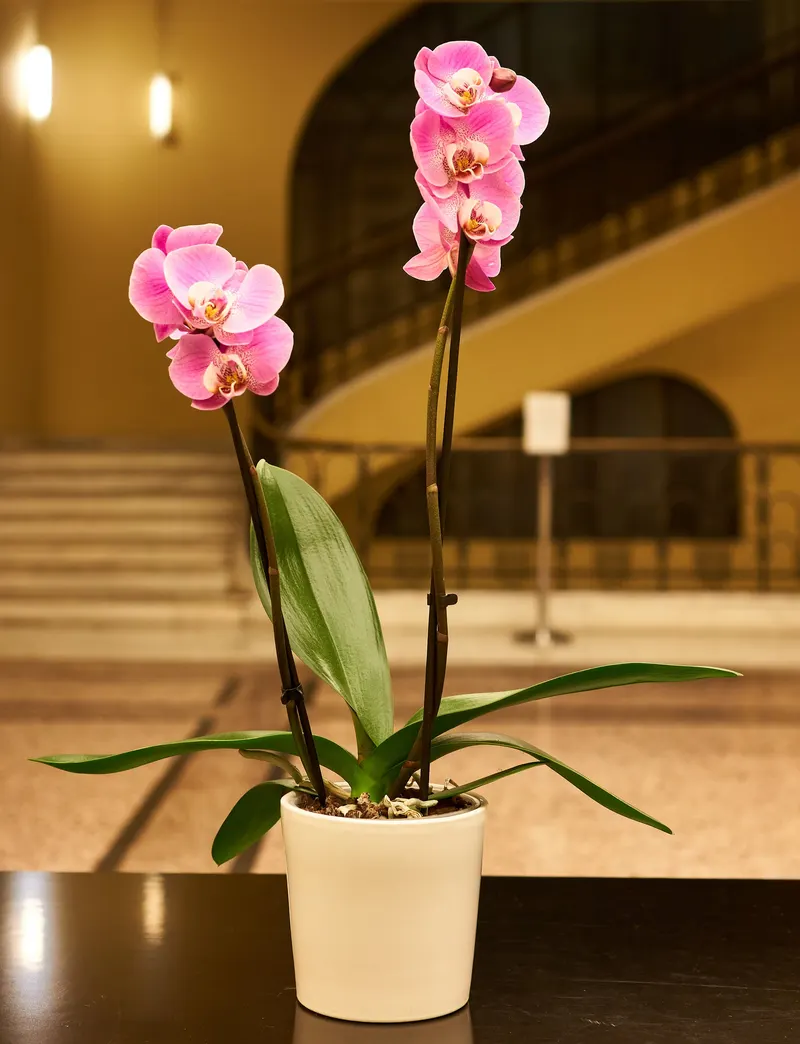
The moth orchid, also simply called Phalaenopsis after its genus, is the most popular orchid for the home1. Its flowers often last four months and longer1, and it copes well with heated rooms2. On top of that, it is non-toxic for people, cats and dogs3,4.
Origin & history
In the wild, the genus grows in tropical and subtropical Asia as far as north-eastern Australia6. There it grows on trees as an epiphyte6,1.
The genus name Phalaenopsis means "moth-like" – the flowers resemble moths in flight1,7. It is bred mainly in Taiwan and the Netherlands, and more than 34,000 hybrids are registered1.
Caution
It isn't toxic for cats and dogs3, and for people it's considered harmless4.
Care
Light. Bright in winter, a window with morning or evening sun is ideal. No direct sun in summer, it burns the leaves2.
Water. In the growing season, water thoroughly with lukewarm water about once a week or dunk briefly and let it drain well. Too wet and the roots rot, too dry and they shrivel up2.
Temperature & humidity. 19–30 °C by day, 16–19 °C at night2; the RHS advises keeping it above 16 °C, and Iowa State says to avoid anything below 13 °C8. It likes 40–60 % humidity – a tray of wet gravel helps8.
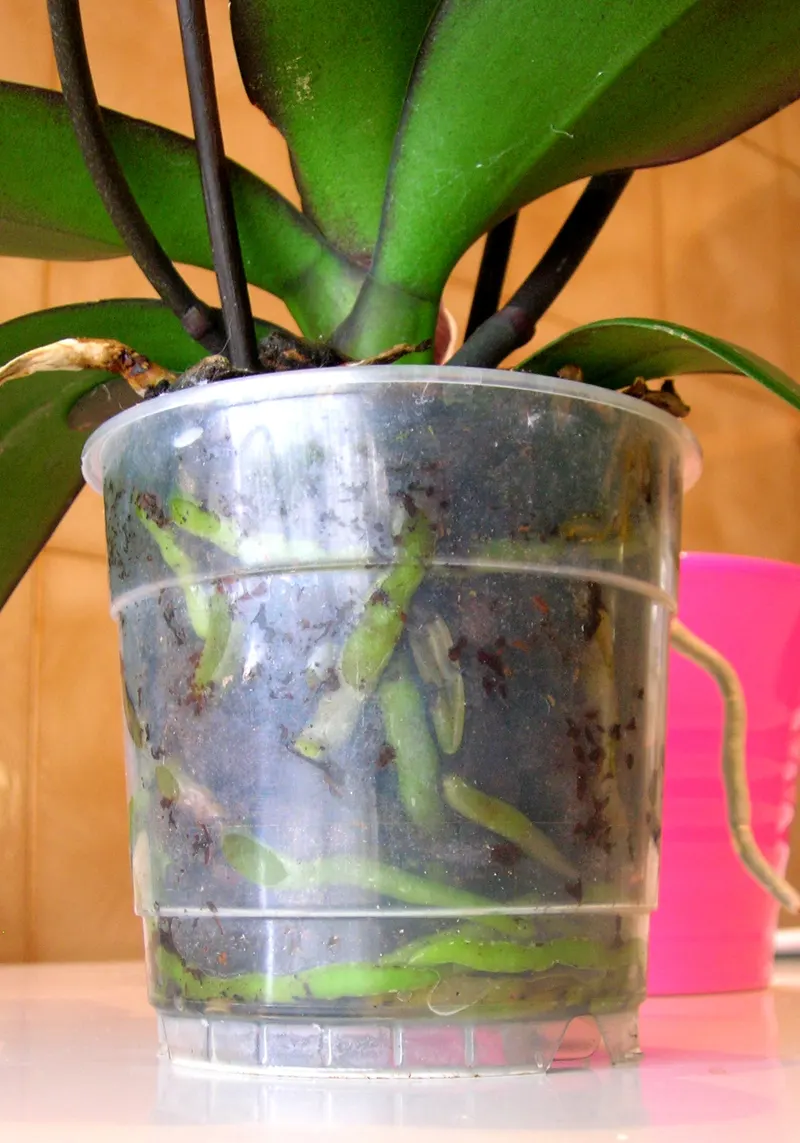
Soil, pot & repotting. Only bark-based orchid mix, never potting compost. A clear pot shows whether it's still moist inside. Don't bury aerial roots, or they rot2. Repot into fresh bark every two to three years after flowering, not while in bloom1,7,9.
Feeding. From spring into early autumn9, twice a month with orchid fertiliser at half strength1, every fourth time just water; hardly at all in winter2.
Extras
After flowering, cut the stalk above the second node below the faded flowers – a new flower branch often sprouts there2. If it goes without flowers for a long time, keep it around 5 °C cooler for about a month2.
Its roots are green because they photosynthesise themselves1. The leaves use water-saving CAM photosynthesis and take in CO₂ mainly at night10.
By the way, blue orchids are usually dyed. When they flower again, the flowers are white1.

Symptoms & help
| too little | too much | |||
|---|---|---|---|---|
| Water | The roots shrivel and die. → Water the pot thoroughly or dunk it, then water weekly. Never let the bark dry out completely. | Roots rot, leaves shrivel anyway. → Take it out of the pot, cut off rotten roots, replant in fresh bark. After that, only water once the bark has dried a little. | ||
| Light | It doesn't flower again. → Especially in winter, move it to a bright window, one with morning sun, say. | Leaves get burnt patches. → In summer, move it out of direct sun, behind a net curtain, say. | ||
| Fertiliser | Little new growth. → In the growing season, feed every two weeks with orchid fertiliser at half strength. | |||
| Warmth | Buds drop after sudden temperature changes, leaves touching a cold window get damaged. → Keep it above 16 °C at night if possible, never below 13 °C. Not against the cold glass, no draughts. | The plant is healthy but doesn't send up a new flower stalk. → For about a month, move it to a spot that is around 5 °C cooler. |
Take it with you
- Plant cardFront and back in A6 landscape – print it and keep it next to the pot
- PDF ↓


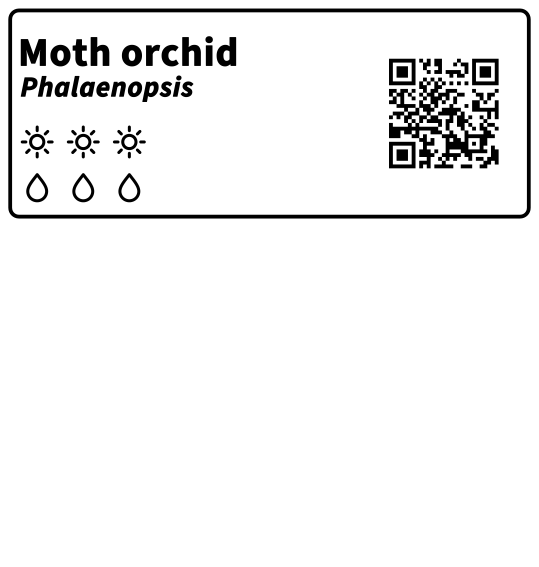
Notes on the files: Print & engrave
Licence and attribution for the plant labels: Readme (TXT)
Sources
- North Carolina State University Extension: Phalaenopsis. North Carolina Extension Gardener Plant Toolbox. https://plants.ces.ncsu.edu/plants/phalaenopsis/ (accessed 14 October 2026)
- Royal Horticultural Society: How to grow Phalaenopsis (moth orchids). RHS Growing Guide. https://www.rhs.org.uk/plants/phalaenopsis/growing-guide (accessed 14 October 2026)
- ASPCA Animal Poison Control Center: Phalaenopsis Orchid (Phalaenopsis sp.). Toxic and Non-Toxic Plant List. https://www.aspca.org/pet-care/aspca-poison-control/toxic-and-non-toxic-plants/phalaenopsis-orchid (accessed 14 October 2026)
- Tox Info Suisse (2014): Harmlose Zimmer- und Balkonpflanzen. Tox Info Suisse, Zürich. https://www.toxinfo.ch/customer/files/923/Harmlose-Pflanzen-fuer-Tox-Info-Suisse198.pdf (accessed 14 October 2026)
- South, K. A., Thomas, P. A., van Iersel, M. W., Young, C. & Jones, M. L. (2017): Ice Cube Irrigation of Potted Phalaenopsis Orchids in Bark Media Does Not Decrease Display Life. HortScience 52(9), 1271–1277. doi:10.21273/HORTSCI12212-17
- Royal Botanic Gardens, Kew: Phalaenopsis Blume. Plants of the World Online. https://powo.science.kew.org/taxon/urn:lsid:ipni.org:names:30326-1 (accessed 14 October 2026)
- Colorado State University Extension: Orchid: Phalaenopsis. PlantTalk Colorado 1350. https://planttalk.colostate.edu/topics/houseplants/1350-orchid-phalaenopsis/ (accessed 14 October 2026)
- Iowa State University Extension and Outreach (2025): What is the proper care for a moth orchid? Yard and Garden. https://yardandgarden.extension.iastate.edu/faq/what-proper-care-moth-orchid (accessed 14 October 2026)
- Arena, M. (2020): General Care for Phalaenopsis Orchids. Clemson Cooperative Extension, Home & Garden Information Center. https://hgic.clemson.edu/general-care-for-phalaenopsis-orchids/ (accessed 14 October 2026)
- van Tongerlo, E. (2021): From diel photosynthesis to crop growth in the crassulacean acid metabolism (CAM) orchid Phalaenopsis. Dissertation, Wageningen University & Research. doi:10.18174/546752
- Missouri Botanical Garden: Repotting Phalaenopsis (Moth) & Other Monopodial Orchids. Visual Guides for the Home Gardener. https://www.missouribotanicalgarden.org/gardens-gardening/your-garden/help-for-the-home-gardener/advice-tips-resources/visual-guides/repotting-phalaenopsis-and-other-monopodial-orchid (accessed 14 October 2026)
- Lüttge, U. (2004): Ecophysiology of Crassulacean Acid Metabolism (CAM). Annals of Botany 93, 629–652. doi:10.1093/aob/mch087