What it does for you
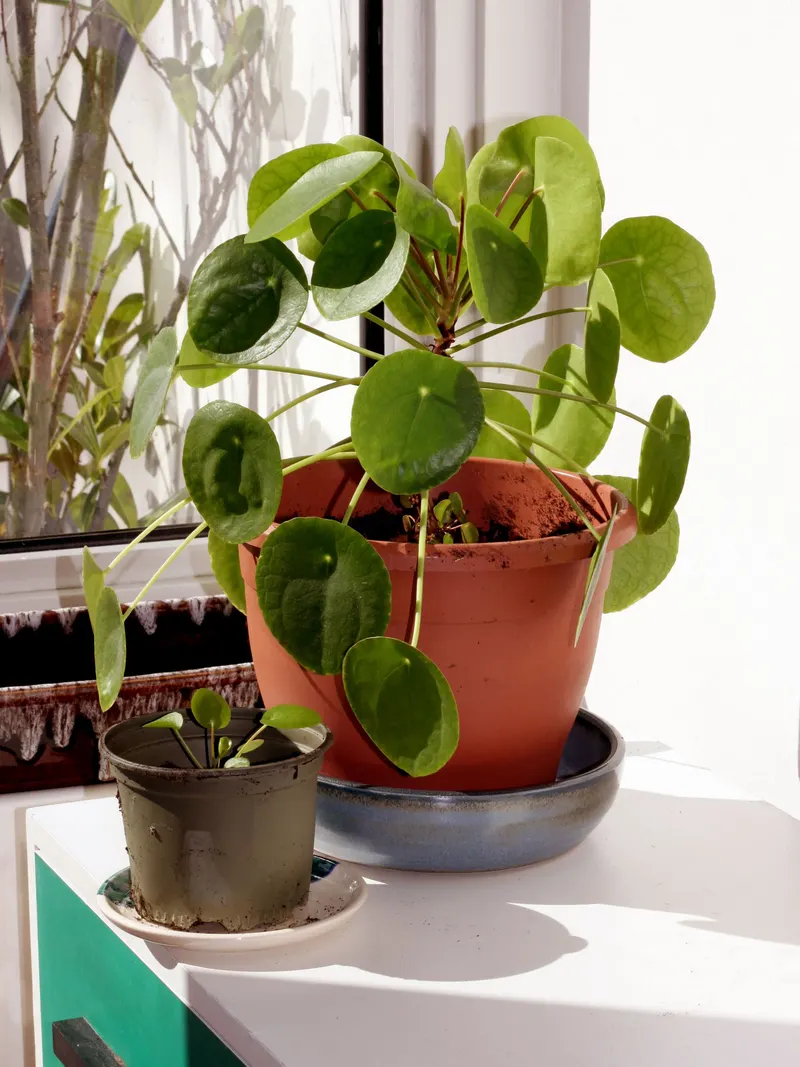
The round, fleshy leaves sit like little plates on long stalks, with the stalk attached in the middle of the leaf's underside1. At about 20–30 cm tall it fits on any windowsill, and it's considered easy-care and non-toxic to pets1. And it keeps producing offsets that you can separate and give away2.
Origin & history
In the wild it is only known from south-west China, in Sichuan and Yunnan4, on shady, damp rocks in forests at 1500–3000 m altitude. There it is very rare and possibly endangered3.
In 1945 a Norwegian missionary found it at a market in Yunnan and took offshoots with him to Norway when he fled. From there it travelled from hand to hand across Europe for decades, without any nurseries – it only reached garden centres recently5.
Caution
The Chinese money plant is considered non-toxic to children and pets1. The ASPCA doesn't list the species itself, but rates the related Pilea involucrata as non-toxic to cats and dogs6.
Care
Light. Bright, but without direct sun7. The RHS suggests a window facing north, east or west (south, east or west in the southern hemisphere); in a room with midday sun, set it back from the window2.
Water. Water when the top few centimetres of soil start to dry – check with the finger test or by lifting the pot. It needs less in winter. Never leave it standing in water, or the roots will rot2. Keep the leaves dry if you can: wet foliage easily gets spots1.
Temperature & humidity. 18–24 °C by day, above 13 °C at night7, always above 10 °C and away from cold draughts2. Normal room air is fine, though it likes it a little more humid1,2.
Soil, pot & repotting. Peat-free potting compost2. For faster drainage you can optionally mix in some cactus soil – Penn State suggests this for pileas that like fast drainage7. Check the roots every spring and repot when it gets crowded, usually every two years or so – into a pot only slightly bigger2.
Feeding. From spring to early autumn feed with liquid fertiliser every one to two months, don't overfeed2.
Extras
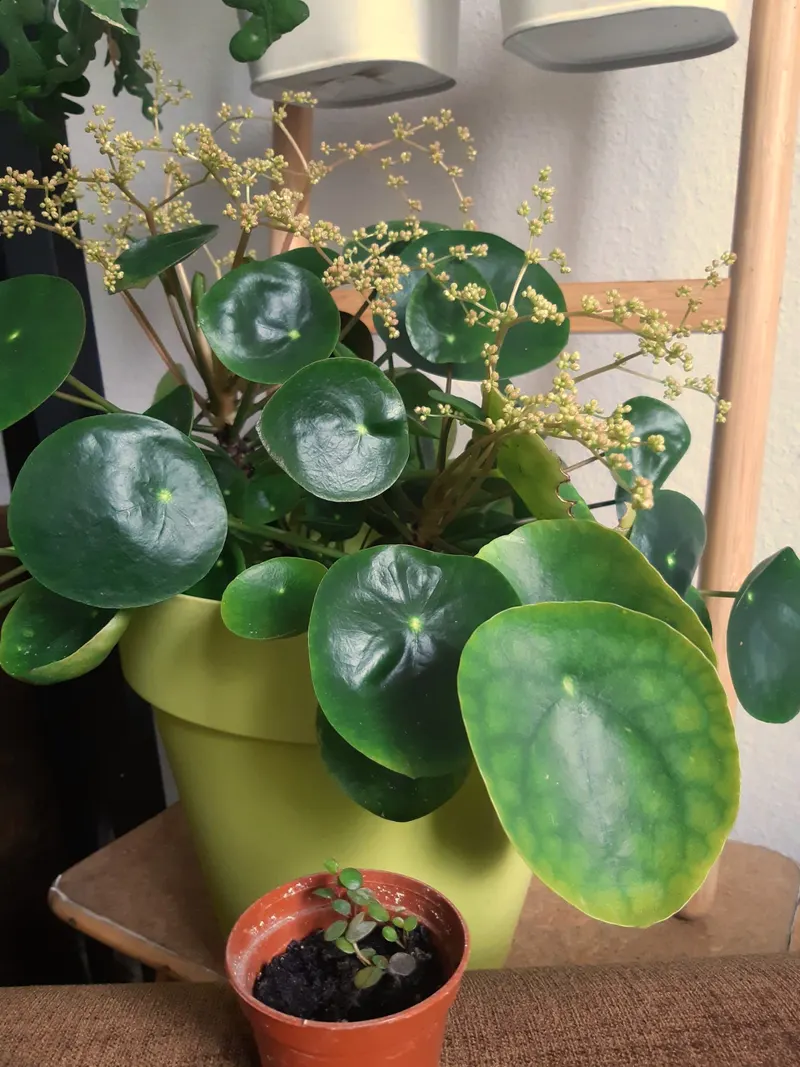
Indoors it rarely flowers1. White specks under the leaves are usually harmless mineral deposits or sap that has leaked out when temperatures fluctuate2. The main pests are spider mites, mealybugs, fungus gnats and scale insects1. The RHS has given it the Award of Garden Merit8.

Symptoms & help
| too little | too much | |||
|---|---|---|---|---|
| Water | The leaves curl or pucker. → Water thoroughly as soon as the top few centimetres of soil are dry. | Leaves curl, the roots rot. → Let the soil dry out, tip away water in the cachepot, water less often. | ||
| Light | Long, thin stalks, the plant gets leggy, leaves curl. → Move it somewhere brighter, e.g. right at a window with morning or evening sun. | The leaves turn reddish brown. → Take it out of direct sun or move it a little away from the sunny window. | ||
| Fertiliser | Leaves turn yellow between the veins. → Feed with liquid fertiliser every four to eight weeks from spring to early autumn. |
Take it with you
- Plant cardFront and back in A6 landscape – print it and keep it next to the pot
- PDF ↓
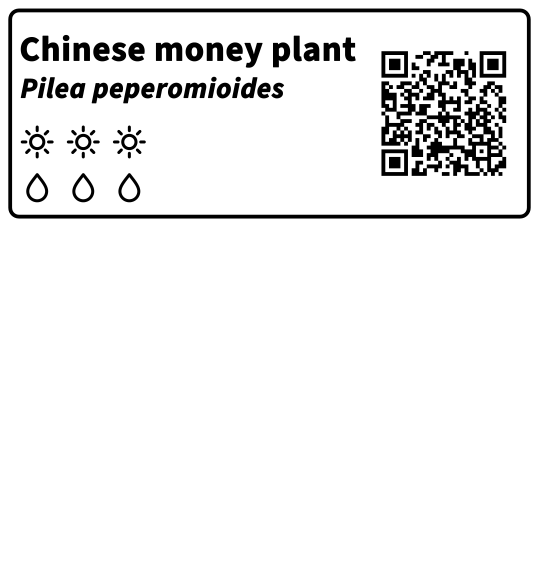
Notes on the files: Print & engrave
Licence and attribution for the plant labels: Readme (TXT)
Sources
- NC State Extension: Pilea peperomioides. North Carolina Extension Gardener Plant Toolbox. https://plants.ces.ncsu.edu/plants/pilea-peperomioides/ (accessed 14 October 2026)
- Royal Horticultural Society: How to grow pileas. RHS Growing Guides. https://www.rhs.org.uk/plants/pilea/how-to-grow-pilea (accessed 14 October 2026)
- Chen, C. J., Friis, I. & Wilmot-Dear, C. M. (2003): Pilea peperomioides Diels. Flora of China, Vol. 5 (Urticaceae). http://www.efloras.org/florataxon.aspx?flora_id=2&taxon_id=242338100 (accessed 14 October 2026)
- Royal Botanic Gardens, Kew: Pilea peperomioides Diels. Plants of the World Online. https://powo.science.kew.org/taxon/urn:lsid:ipni.org:names:855664-1 (accessed 14 October 2026)
- Hodgson, L. (2020): The Pass-Along Pilea. Laidback Gardener (blog). https://laidbackgardener.blog/2020/01/06/the-pass-along-pilea/ (accessed 14 October 2026)
- ASPCA Animal Poison Control Center: Friendship Plant (Pilea involucrata). Toxic and Non-Toxic Plant List. https://www.aspca.org/pet-care/aspca-poison-control/toxic-and-non-toxic-plants/friendship-plant (accessed 14 October 2026)
- Smith, M. L. (2025): Pilea as a Houseplant. Penn State Extension. https://extension.psu.edu/pilea-as-a-houseplant (accessed 14 October 2026)
- Royal Horticultural Society: Pilea peperomioides. RHS Plants. https://www.rhs.org.uk/plants/13015/wd/details (accessed 14 October 2026)
- Royal Horticultural Society: How to take cuttings from houseplants. RHS Growing Guide. https://www.rhs.org.uk/plants/types/houseplants/how-to-take-cuttings-from-houseplants (accessed 14 October 2026)
- DelPrince, J. M. & Perry, J. H. (2021): Care & Selection of Indoor Plants. Mississippi State University Extension, Publication 1012. https://extension.msstate.edu/publications/care-selection-indoor-plants (accessed 11 October 2026)