What it does for you
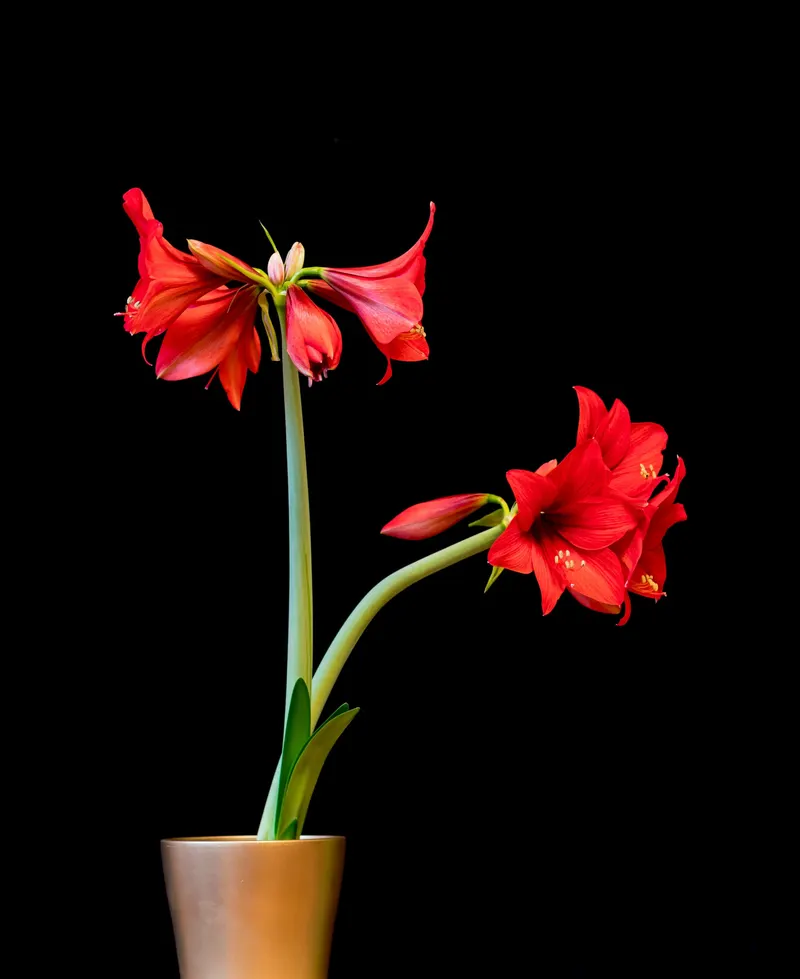
The amaryllis brings big flowers into winter: six to eight weeks after potting, two to six trumpets open on one stalk1,2. The trade stores the dormant bulbs and brings them into flower just in time for the run-up to Christmas3.
Origin & history
The roughly 90 species grow wild in Central and South America, above all in eastern Brazil and in the Andes5,2.
The name is a mistake with a history: Linnaeus called the plant Amaryllis in 1737. In 1819 William Herbert coined the name Hippeastrum for the American species6. The true Amaryllis is the belladonna lily from South Africa3. But the hippeastrum is still usually called "amaryllis"7,4. It has been bred since 1799, and most varieties on sale descend from six species2.
Caution
All parts contain alkaloids such as lycorine, the bulb most of all8. The bulb is considered highly toxic4: vomiting, drooling and diarrhoea, in larger amounts seizures and heart rhythm problems8. It is toxic for cats and dogs too9.
Care
Light. As bright as possible, ideally with some direct sun – that's the most important point for the next flowering10. Turn the pot regularly1.
Water. Sparingly until leaves appear, then regularly, without water left in the saucer1. Let the top of the soil dry out10.
Temperature & humidity. Around 21 °C to start growing, 15–18 °C in flower – then the flowers last longer1.
Soil, pot & repotting. Peat-free potting compost in a pot only slightly bigger than the bulb. The sources disagree on how far the bulb should stick out: two thirds1, half2 or at least a third11,10. It flowers better a little pot-bound10. Repot every two to three years after flowering1.
Feeding. After flowering until early autumn about once a month11 – the RHS even recommends weekly1.
Extras
How to get the next flowers: cut off spent flowers, leave the leaves, water and feed; in summer it can go outside1. From early autumn water less or stop altogether1 and let it rest in the dark at 7–13 °C2 – for eight to ten weeks according to the RHS and Wisconsin, up to twelve according to Illinois1,2,11. Then move it somewhere bright and water again – after four to six weeks it flowers11.

Symptoms & help
| too little | too much | |||
|---|---|---|---|---|
| Water | The next winter no flower stalk appears. → After flowering let the leaves keep growing – water and feed them until early autumn. | The bulb rots. → Keep the soil only slightly moist, let the top dry out, don't leave water in the saucer. | ||
| Light | Long, soft leaves that flop over, the flower stalk leans towards the window, no flowers the next year. → Move it to the brightest window, turn the pot regularly, put it outside in the sun in summer. | The flowers fade quickly in a warm spot. → While it flowers, keep it cooler (15–18 °C) – then the flowers last longer. | ||
| Warmth | Without a cool rest the time of flowering is hard to control. → From early autumn let it rest dry for eight to ten weeks at 7–13 °C. |
Take it with you
- Plant cardFront and back in A6 landscape – print it and keep it next to the pot
- PDF ↓


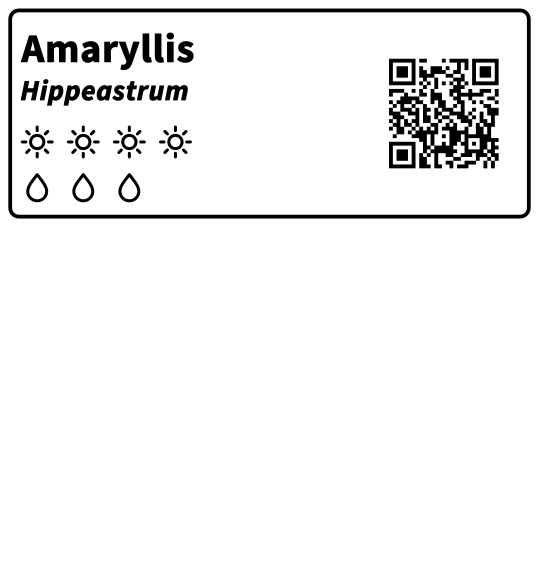
Notes on the files: Print & engrave
Licence and attribution for the plant labels: Readme (TXT)
Sources
- Royal Horticultural Society: How to grow hippeastrum. RHS Growing Guide. https://www.rhs.org.uk/plants/hippeastrum/growing-guide (accessed 14 October 2026)
- Mahr, S. (rev. Spangenberg, B.) (2025): Amaryllis, Hippeastrum. University of Wisconsin–Madison Extension, Wisconsin Horticulture. https://hort.extension.wisc.edu/articles/amaryllis-hippeastrum/ (accessed 14 October 2026)
- Universitätsbibliothek Regensburg (2015): Der Ritterstern: Moderne Taxonomie. Virtuelle Ausstellung „Der Ritterstern, die ritterliche Weihnachtszwiebel“. https://www.uni-regensburg.de/bibliothek/ub/veranstaltungen/virtuelle-ausstellungen/der-ritterstern-die-ritterliche-weihnachtszwiebel/der-ritterstern-und-seine-verwandten/moderne-taxonomie (accessed 14 October 2026)
- Schlag-Edler, B. (2013): Zwiebeln für’s Gemüt – Teil I. Botanischer Garten der Universität Wien, Infoblatt. https://botanischergarten.univie.ac.at/fileadmin/user_upload/p_botanischergarten/Infoblaetter/Ausstellungen/ib_zwiebel1_gesundheitstag.pdf (accessed 14 October 2026)
- Royal Botanic Gardens, Kew: Hippeastrum Herb. Plants of the World Online. https://powo.science.kew.org/taxon/urn:lsid:ipni.org:names:331211-2 (accessed 14 October 2026)
- Universitätsbibliothek Regensburg (2015): Der Ritterstern: Entdeckung und historische Taxonomie. Virtuelle Ausstellung „Der Ritterstern, die ritterliche Weihnachtszwiebel“. https://www.uni-regensburg.de/bibliothek/ub/veranstaltungen/virtuelle-ausstellungen/der-ritterstern-die-ritterliche-weihnachtszwiebel/der-ritterstern-und-seine-verwandten/entdeckung-und-historische-taxonomie (accessed 14 October 2026)
- Universitätsbibliothek Regensburg (2015): Der Ritterstern, die ritterliche Weihnachtszwiebel. Virtuelle Ausstellung. https://www.uni-regensburg.de/bibliothek/ub/veranstaltungen/virtuelle-ausstellungen/der-ritterstern-die-ritterliche-weihnachtszwiebel (accessed 14 October 2026)
- NC State Extension: Hippeastrum. North Carolina Extension Gardener Plant Toolbox. https://plants.ces.ncsu.edu/plants/hippeastrum/ (accessed 14 October 2026)
- ASPCA Animal Poison Control Center: Amaryllis. Toxic and Non-Toxic Plant List. https://www.aspca.org/pet-care/animal-poison-control/toxic-and-non-toxic-plants/amaryllis (accessed 14 October 2026)
- Bosmans, R. (rev. Ricigliano, D.) (2023): Amaryllis Care. University of Maryland Extension, Home & Garden Information Center. https://extension.umd.edu/resource/amaryllis-care (accessed 14 October 2026)
- Johnson, K. (2021): How to take care of amaryllis and get them to rebloom. University of Illinois Extension, Good Growing (blog). https://extension.illinois.edu/blogs/good-growing/2021-12-03-how-take-care-amaryllis-and-get-them-rebloom (accessed 14 October 2026)
- Royal Horticultural Society: Hippeastrum 'Royal Red'. RHS Plants. https://www.rhs.org.uk/plants/368034/hippeastrum-royal-red/details (accessed 14 October 2026)
- Michigan State University Extension (2014): Growing amaryllis, a favorite holiday plant. MSU Extension News. https://www.canr.msu.edu/news/growing_amaryllis_a_favorite_holiday_plant (accessed 14 October 2026)