What it does for you
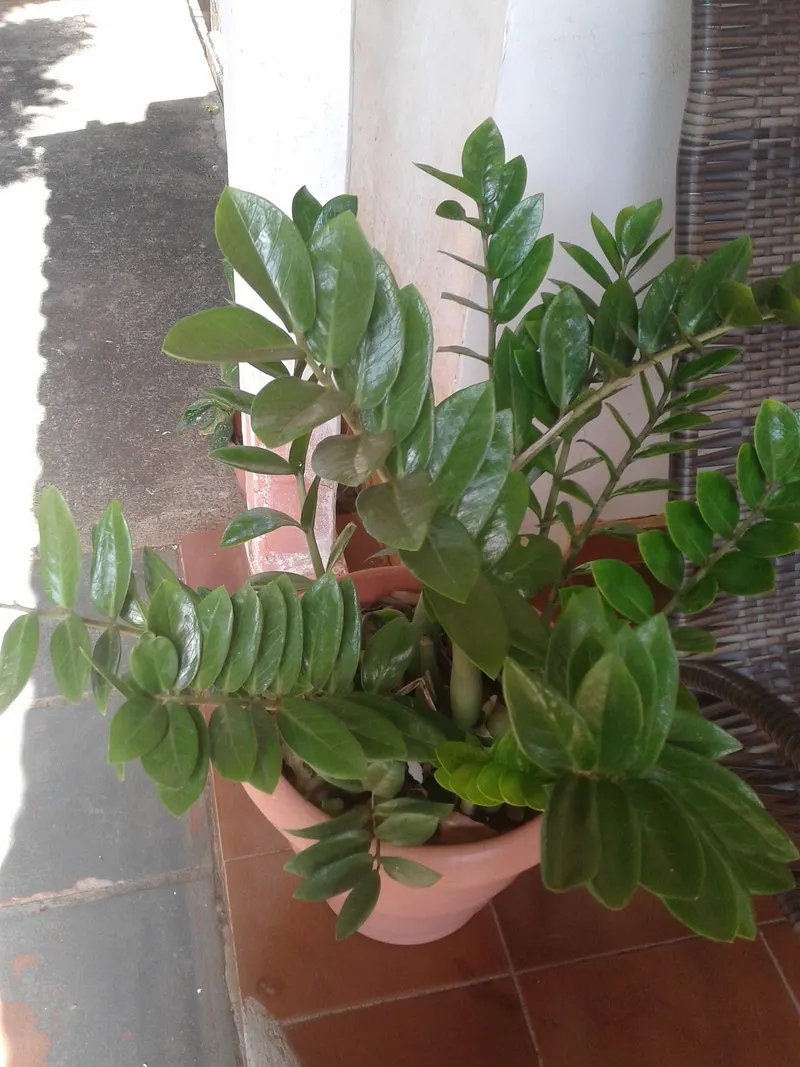
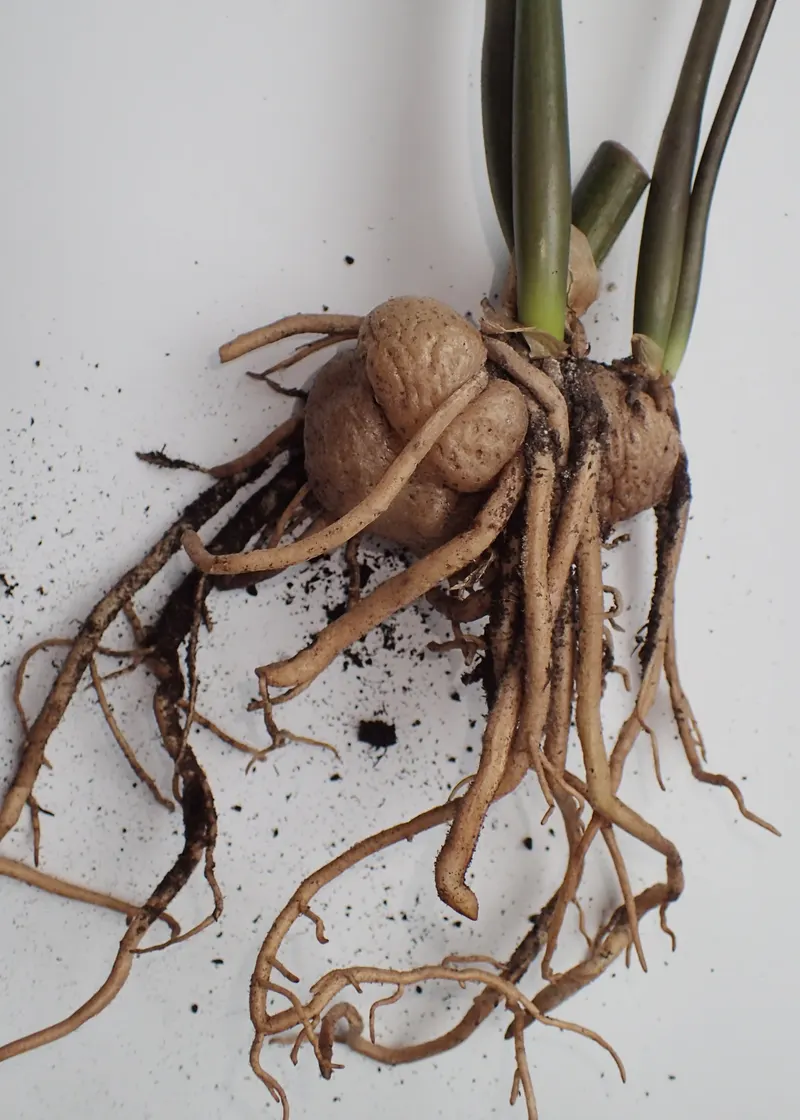
The ZZ plant stores water in its thick rhizomes, and its waxy leaves lose hardly any through evaporation. That way it can go three to four months without watering1. For you, that means: holidays, a forgotten watering can – no problem. It uses water very slowly2, so it also adds little to the humidity. Its leaves are naturally so glossy that they look polished1.
Origin & history
The ZZ plant comes from eastern Africa, from Kenya and Tanzania via Malawi, Mozambique and Zimbabwe to KwaZulu-Natal in South Africa4. There it grows in dry, open savanna woodland3.
Its species name zamiifolia means "with leaves like Zamia" – a genus of cycads it isn't related to at all5. Clemson also links the nickname "ZZ" to its resemblance to Zamia3. In 2002 the Florida Nurserymen and Growers Association named it a Florida Plant of the Year1.
Caution
The ZZ plant contains calcium oxalate. If leaves are eaten in larger amounts, vomiting and diarrhoea can follow. For cats and dogs it is considered moderately toxic5 – so keep it out of reach of pets and children. Sources differ on skin contact: NC State reports no contact dermatitis, the RHS lists it as a skin and eye irritant. Wear gloves when cutting5,6.
Care
Light. Best bright without direct sun; harsh sun scorches the leaves5. It copes with little light, but then grows even more slowly than it already does3.
Water. Only water once the soil has dried out completely – once or twice a month3, in winter about once a month5. It can't stand wet feet: too much water makes the roots rot3.
Temperature & humidity. Indoors, 20–24 °C is ideal1. It is sensitive to cold – not below 16 °C3. Normal room air is enough for it3.
Soil, pot & repotting. Coarse, free-draining soil, about half potting compost and half perlite and sand3. As a rule of thumb, ready-made cactus soil works too, and you repot every two to three years when the rhizomes fill the pot – only one size bigger.
Feeding. Only once or twice during the growing season3.
Extras
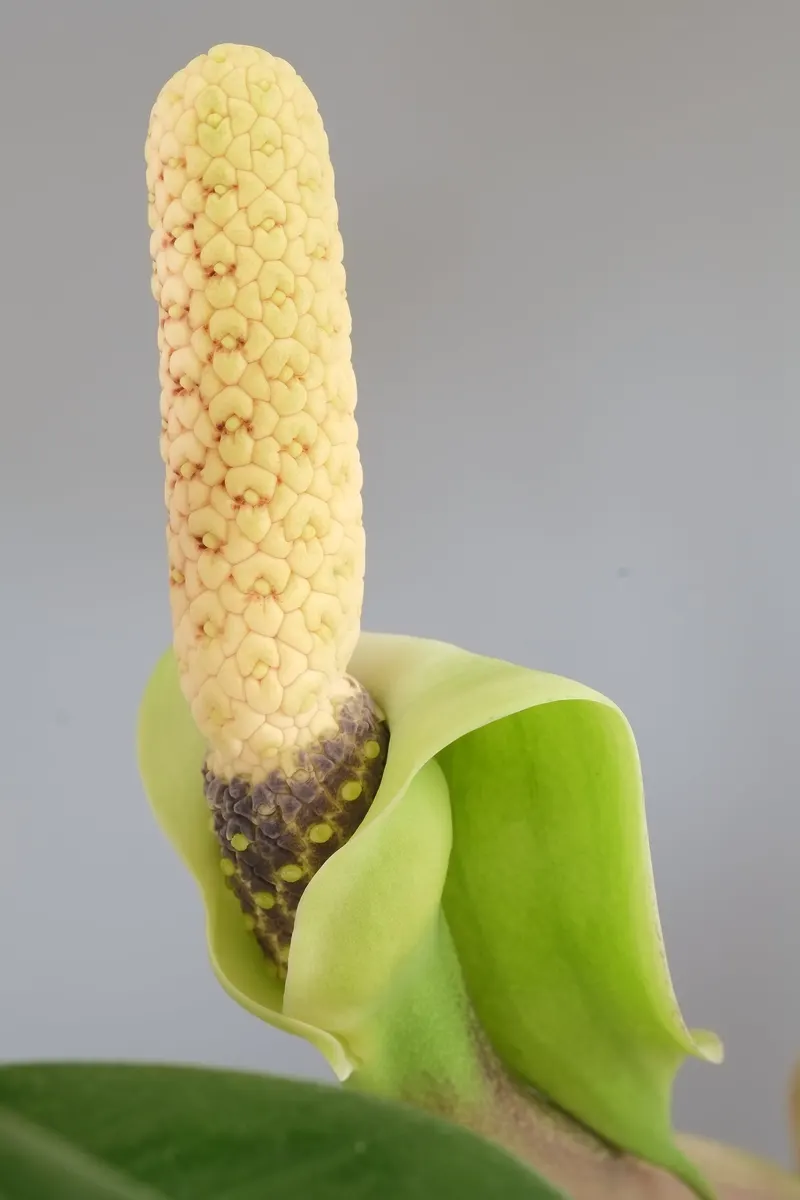
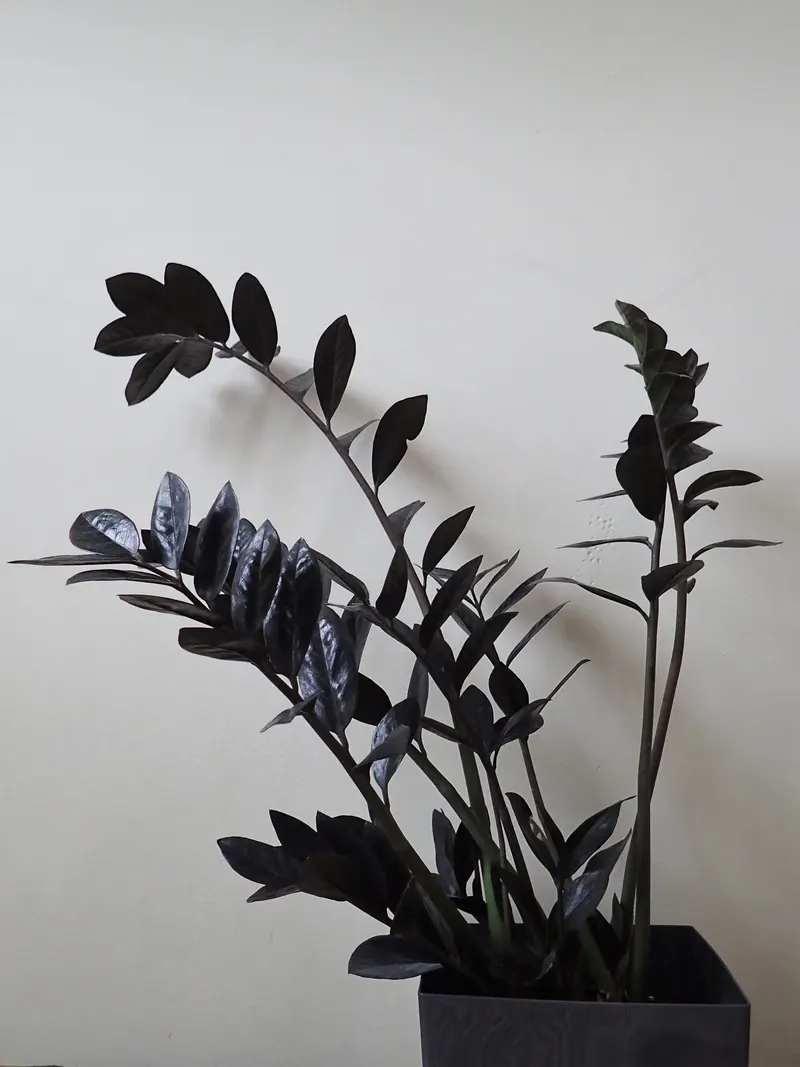
Flowers are rare: a spike in a light green bract3. Popular varieties: 'Raven' with almost black leaves, 'Zenzi' as a dwarf form and 'Chameleon', whose leaves come out yellow3.



Symptoms & help
| too little | too much | |||
|---|---|---|---|---|
| Water | Leaflets drop, the plant loses its foliage when it dries out completely. → Water thoroughly, then let it dry out again. | The plant weakens, the soil stays wet, roots rot. → Take it out of the pot, cut off rotten parts, replant in fresh, dry soil and don't water until it has dried out. | ||
| Light | Hardly any new shoots, it grows even more slowly than usual. → Move it somewhere brighter. Even then, new shoots only come slowly. | Brown, scorched patches on the leaves. → Move it out of direct sun. Scorched leaflets stay patchy. | ||
| Warmth | Leaves suffer – often after cold at the window. → Move it somewhere warmer, keep it dry, cut damaged stalks off at the base. |
Take it with you
- Plant cardFront and back in A6 landscape – print it and keep it next to the pot
- PDF ↓


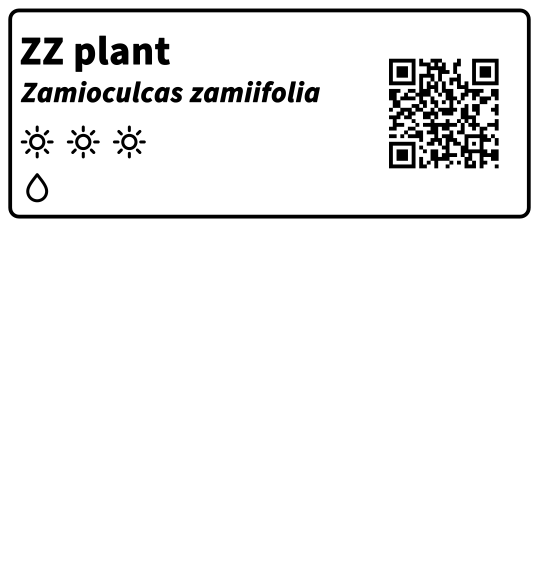
Notes on the files: Print & engrave
Licence and attribution for the plant labels: Readme (TXT)
Sources
- McConnell, D., Henny, R. J. & Chen, J.: Cultural Guidelines for Commercial Production of Interiorscape ZZ (Zamioculcas zamiifolia). UF/IFAS Extension, ENH997/EP252. https://ask.ifas.ufl.edu/publication/EP252 (accessed 11 October 2026)
- Gubb, C., Blanusa, T., Griffiths, A. & Pfrang, C. (2018): Can houseplants improve indoor air quality by removing CO2 and increasing relative humidity? Air Quality, Atmosphere & Health 11, 1191–1201. doi:10.1007/s11869-018-0618-9
- Jordan, J. (2026): ZZ Plant (Zamioculcas zamiifolia): Indoor Care, Growing Tips & Plant Guide. Clemson Cooperative Extension, Home & Garden Information Center, HGIC 1570. https://hgic.clemson.edu/factsheet/zz-plant-zamioculcas-zamiifolia-indoor-care-growing-tips-plant-guide/ (accessed 11 October 2026)
- Royal Botanic Gardens, Kew: Zamioculcas zamiifolia (G.Lodd.) Engl. Plants of the World Online. https://powo.science.kew.org/taxon/urn:lsid:ipni.org:names:89402-1 (accessed 11 October 2026)
- NC State Extension: Zamioculcas zamiifolia. North Carolina Extension Gardener Plant Toolbox. https://plants.ces.ncsu.edu/plants/zamioculcas-zamiifolia/ (accessed 11 October 2026)
- Royal Horticultural Society: Zamioculcas zamiifolia (Zanzibar gem). RHS Plants. https://www.rhs.org.uk/plants/19185/zamioculcas-zamiifolia/details (accessed 12 October 2026)
- Missouri Botanical Garden: Zamioculcas zamiifolia. Plant Finder. https://www.missouribotanicalgarden.org/PlantFinder/PlantFinderDetails.aspx?taxonid=276468 (accessed 12 October 2026)
- Berger, J., Essah, E. & Blanuša, T. (2024): The impact of plants on the humidity of naturally-ventilated office indoor environments. Journal of Building Engineering 86, 108814. doi:10.1016/j.jobe.2024.108814
- DelPrince, J. M. & Perry, J. H. (2021): Care & Selection of Indoor Plants. Mississippi State University Extension, Publication 1012. https://extension.msstate.edu/publications/care-selection-indoor-plants (accessed 11 October 2026)
- Royal Horticultural Society: Palms: indoors. RHS Advice. https://www.rhs.org.uk/plants/types/trees/indoor-palms (accessed 12 October 2026)