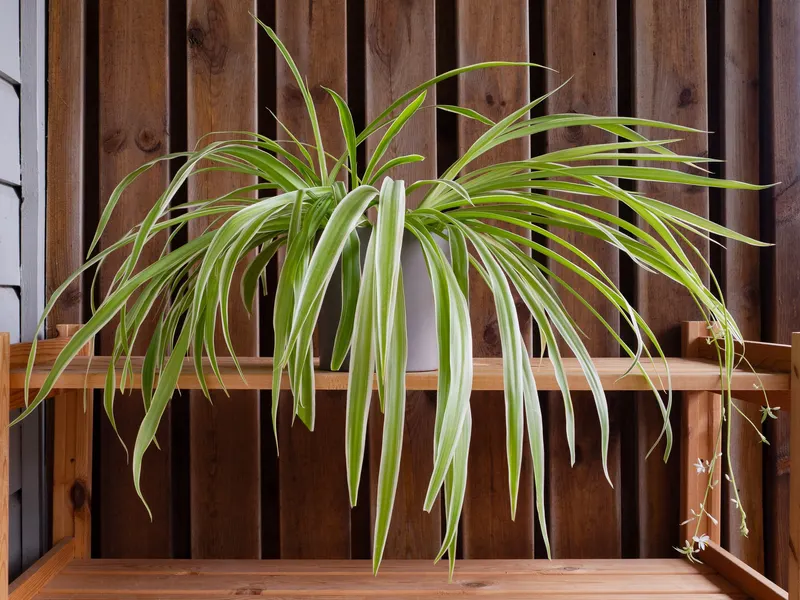
What it does for you
The spider plant is considered one of the easiest houseplants of all1. It stores water in its thick, fleshy roots and so survives the odd forgotten watering2. And it's non-toxic – for cats and dogs3 as well as for people4. On top of that, it grows little plantlets on long stalks that people love to give away. That's how it became one of the most widespread houseplants in the world5.
Origin & history
In the wild, the spider plant grows in tropical West Africa to Cameroon and from Ethiopia to South Africa8. In South Africa you'll find it in the undergrowth of wooded river valleys, in scrub and on cliffs, from the coast to over 1000 metres5.
Carl Peter Thunberg, the "father of South African botany", described it in 1794. Its species name comosum goes back to the Greek kome, a tuft of hair, and refers to the leaf rosette. The Nguni in South Africa traditionally use it as a medicinal plant and to protect mother and child5.
Caution
Good news: the spider plant is non-toxic for cats and dogs3, and the Bonn poison information centre rates it as non-toxic for people too. Still, it isn't meant to be eaten: larger amounts can cause stomach upset and nausea4.
Care
Light. Bright, but without direct sun – harsh summer sun scorches the leaves. It copes with less light, but then grows more slowly and the stripes fade1.
Water. Keep the soil slightly moist1 and let the surface dry a little between waterings9 – as a rule of thumb about once a week in summer, less often in winter. Tip away water in the cachepot. Fluoride in tap water can brown the tips, rainwater is ideal1.
Temperature & humidity. 18–24 °C during the day, a little cooler at night is welcome9, ideally not below 10 °C10. Normal room air is fine – just don't put it right next to the radiator1.
Soil, pot & repotting. Peat-free houseplant soil1 and a pot with a drainage hole. A hanging basket shows off the arching stalks nicely11. Repot every one to two years into a slightly bigger pot1. It forms the most plantlets when it's a little cramped in the pot2; a pot that's too big holds back flowering1.
Feeding. From spring to early autumn liquid fertiliser about every two months1; too much fertiliser holds back the plantlets11.
Extras
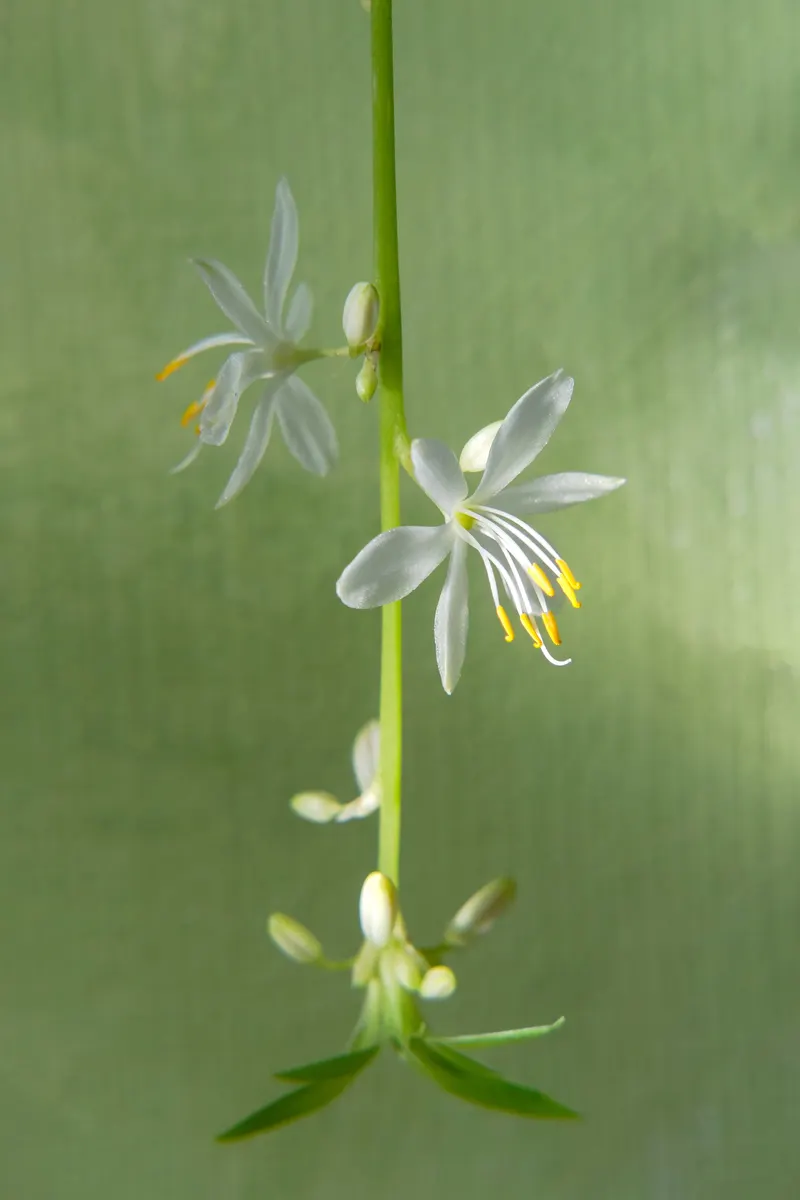
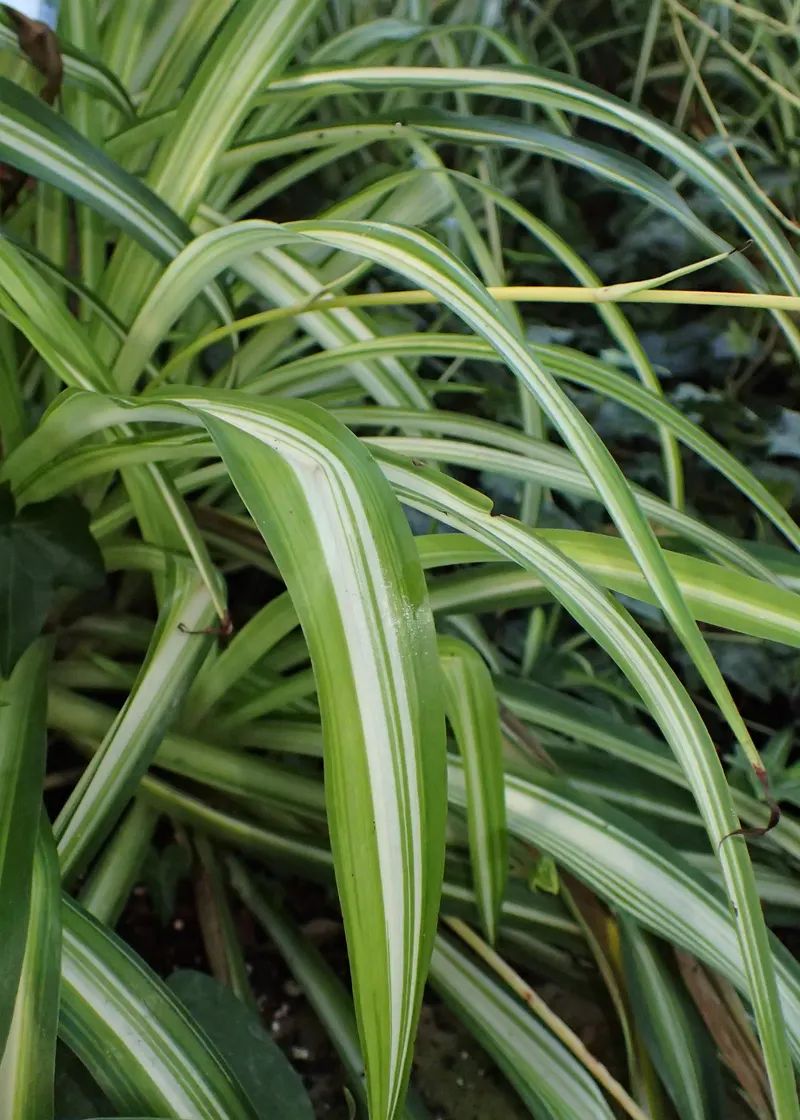
The small white star-shaped flowers sit on the same stalks as the plantlets. The stalks are triggered by short days: if the spider plant gets less than twelve hours of light a day for at least three weeks, it forms them11. Well-known varieties are 'Vittatum' with a white central stripe and 'Variegatum' with white edges2.


Symptoms & help
| too little | too much | |||
|---|---|---|---|---|
| Water | Leaves turn pale and dull, the tips brown. → Water thoroughly and more regularly from now on. You can cut off brown tips. | The soil stays wet all the time, the plant weakens, roots rot. → Take it out of the pot, remove rotten roots, replant in fresh, free-draining soil and water more sparingly. | ||
| Light | Slow growth, yellowish leaves, the stripes fade, hardly any plantlets. → Move it somewhere brighter, but not into harsh sun. | Yellow to brown, scorched patches – especially in summer. → Move it out of direct sun and cut off scorched leaves. | ||
| Fertiliser | Hardly grows any more, even though the spot is bright. → Repot into fresh soil or feed every two months from spring to early autumn. | Brown leaf tips, hardly any plantlets. → Flush the soil thoroughly and don't feed for a few months. | ||
| Warmth | Forms no flowers or plantlets. → Move it somewhere warmer and in winter keep it a little away from cold windows and draughts. |
Take it with you
- Plant cardFront and back in A6 landscape – print it and keep it next to the pot
- PDF ↓
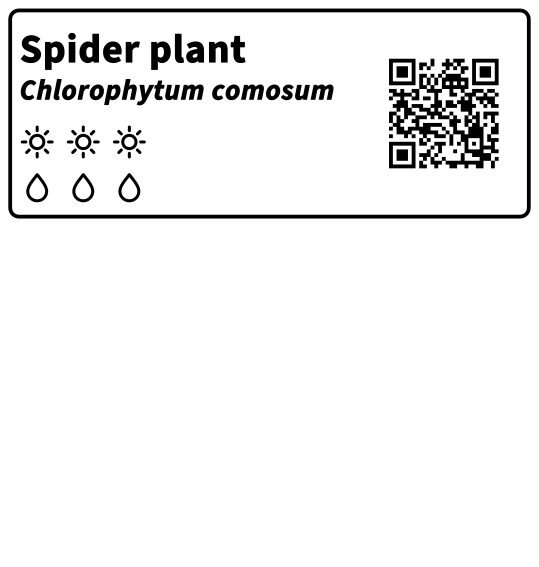
Notes on the files: Print & engrave
Licence and attribution for the plant labels: Readme (TXT)
Sources
- Royal Horticultural Society: How to grow spider plants. RHS Growing Guides. https://www.rhs.org.uk/plants/spider-plants/growing-guide (accessed 11 October 2026)
- Mahr, S. (2025): Spider plant, Chlorophytum comosum. University of Wisconsin–Madison Division of Extension, Wisconsin Horticulture. https://hort.extension.wisc.edu/articles/spider-plant-chlorophytum-comosum/ (accessed 11 October 2026)
- ASPCA Animal Poison Control Center: Spider Plant (Chlorophytum comosum). Toxic and Non-Toxic Plant List. https://www.aspca.org/pet-care/animal-poison-control/toxic-and-non-toxic-plants/spider-plant (accessed 11 October 2026)
- Informationszentrale gegen Vergiftungen Bonn: Grünlilie. Giftzentrale Bonn – Pflanzen. https://gizbonn.de/giftzentrale-bonn/pflanzen/gruenlilie (accessed 17 October 2026)
- van Jaarsveld, E. J. (2012): Chlorophytum comosum. PlantZAfrica, South African National Biodiversity Institute (SANBI). https://pza.sanbi.org/chlorophytum-comosum (accessed 11 October 2026)
- Wolverton, B. C., Johnson, A. & Bounds, K. (1989): Interior Landscape Plants for Indoor Air Pollution Abatement. NASA Technical Memorandum TM-101766. https://ntrs.nasa.gov/citations/19930073077
- Cummings, B. E. & Waring, M. S. (2020): Potted plants do not improve indoor air quality: a review and analysis of reported VOC removal efficiencies. Journal of Exposure Science & Environmental Epidemiology 30, 253–261. doi:10.1038/s41370-019-0175-9
- Royal Botanic Gardens, Kew: Chlorophytum comosum (Thunb.) Jacques. Plants of the World Online. https://powo.science.kew.org/taxon/urn:lsid:ipni.org:names:532810-1 (accessed 11 October 2026)
- Russ, K. & Pertuit, A. (rev. Franklin, N. J.) (2025): Spider Plant (Chlorophytum comosum). Clemson Cooperative Extension, Home & Garden Information Center, HGIC 1513. https://hgic.clemson.edu/factsheet/spider-plant/ (accessed 11 October 2026)
- Royal Horticultural Society: Chlorophytum comosum (spider plant). RHS Plants. https://www.rhs.org.uk/plants/3761/spider-plant/details (accessed 11 October 2026)
- NC State Extension: Chlorophytum comosum. North Carolina Extension Gardener Plant Toolbox. https://plants.ces.ncsu.edu/plants/chlorophytum-comosum (accessed 11 October 2026)
- Berger, J., Essah, E. & Blanuša, T. (2024): The impact of plants on the humidity of naturally-ventilated office indoor environments. Journal of Building Engineering 86, 108814. doi:10.1016/j.jobe.2024.108814
- Royal Horticultural Society: How to take cuttings from houseplants. RHS Growing Guide. https://www.rhs.org.uk/plants/types/houseplants/how-to-take-cuttings-from-houseplants (accessed 14 October 2026)
- DelPrince, J. M. & Perry, J. H. (2021): Care & Selection of Indoor Plants. Mississippi State University Extension, Publication 1012. https://extension.msstate.edu/publications/care-selection-indoor-plants (accessed 11 October 2026)