What it does for you
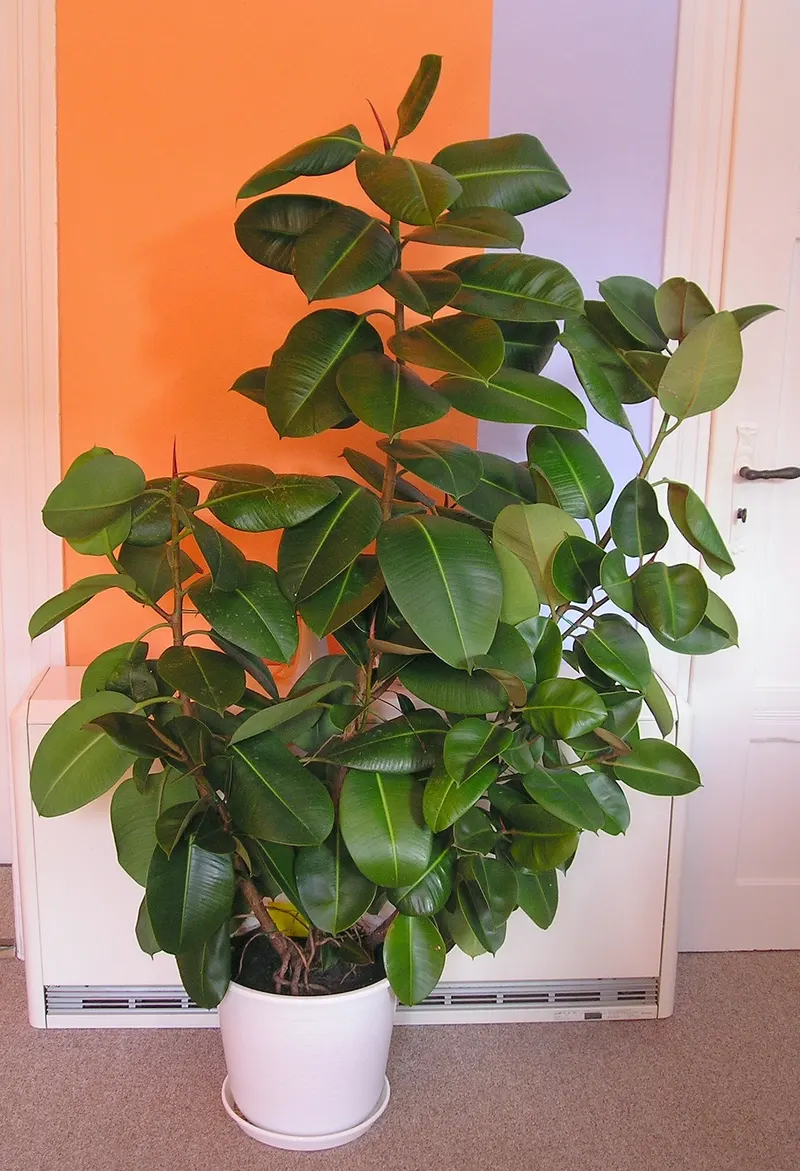
The rubber plant is considered a robust, uncomplicated houseplant1. Its leathery, glossy leaves grow 30 to 45 centimetres long, often with a bronze underside2. Indoors it usually reaches 0.6 to 3 metres; if you cut the main shoots, it grows bushier3.
Origin & history
In the wild, the rubber plant grows from Nepal and north-east India to south-western China and western Malesia, e.g. on Sumatra and Java6. There it reaches up to 30 metres3. It often germinates as a hemiepiphyte on another tree and wraps around it with its aerial roots as a strangler fig7.
Its species name elastica refers to the milky sap that was once used to make rubber3; it was grown for this before and during the colonial era7. In Meghalaya, India, the Khasi and Jaintia grow living bridges over rivers from its aerial roots – up to about 50 metres long and some of them several hundred years old7.
Caution
The Bonn poison information centre classes rubber plants as mildly toxic: rarely, the milky sap irritates the mucous membranes; eating leaves has led to vomiting and stomach ache. Only after very large amounts have cramps been described8. For cats and dogs, the ASPCA lists irritation of the stomach, gut and skin for its close relative, the weeping fig (Ficus benjamina)9. The sticky white sap can irritate the skin and aggravate allergies – wear gloves when cutting1.
Care
Light. Ideally bright, but filtered or indirect2; it tolerates a little morning or evening sun, variegated varieties need more light1. Partial shade works too, afternoon sun doesn't3.
Water. In summer, water regularly with room-temperature water and let the soil dry slightly in between – as a rule of thumb, once the top 2–3 cm are dry. In winter keep it just slightly moist. Too much water is the usual reason for sudden leaf drop1.
Temperature & humidity. Evenly warm, no draughts1, ideally 18–27 °C; below 15 °C it risks cold damage10. Medium humidity3; in dry air a tray of damp gravel helps1.
Soil, pot & repotting. Houseplant soil2 or peat-free, loam-based soil with fine bark1. Repot every 2–3 years, and renew the top layer of soil every year in between2.
Feeding. From spring to late summer1 about monthly with a high-nitrogen fertiliser2.
Extras
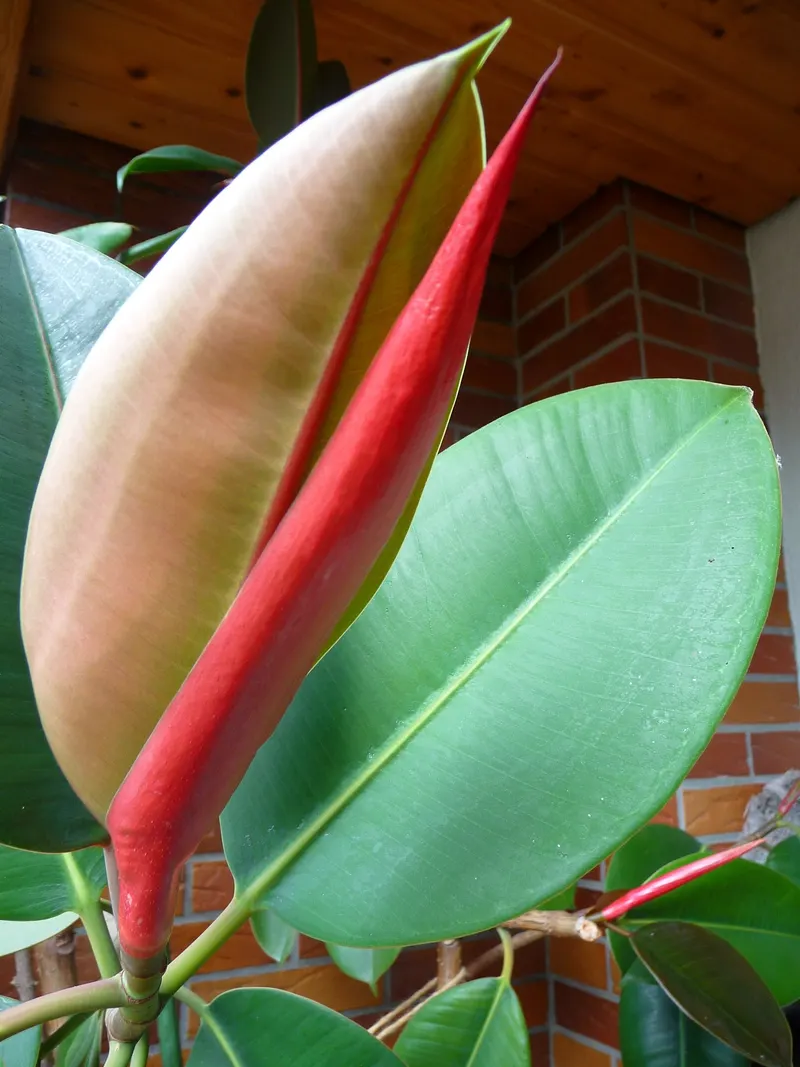
Its pink to purple stipules are typical. The most common variety is 'Robusta' with deep green, waxy leaves; there are also variegated varieties. Wipe the large leaves with a damp cloth now and then. Indoors it rarely flowers. Unpruned it grows tall, narrow and tree-like3.

Symptoms & help
| too little | too much | |||
|---|---|---|---|---|
| Water | Leaves turn yellow and drop, the soil stays wet for a long time. → Water less often, empty the cachepot and let the soil dry slightly before the next watering. | |||
| Light | Green leaves drop. → Move it somewhere brighter, ideally with some morning or evening sun – and then leave it there. | Dry, shrivelled or scorched leaves. → Protect it from harsh midday and afternoon sun. | ||
| Fertiliser | Leaves drop even though light and watering are right. → Don't feed for a few months, then more sparingly. | |||
| Warmth | Leaves suddenly drop – often in winter or in a cold draught. → Move it somewhere warmer and draught-free, not below 15 °C. |
Take it with you
- Plant cardFront and back in A6 landscape – print it and keep it next to the pot
- PDF ↓

Notes on the files: Print & engrave
Licence and attribution for the plant labels: Readme (TXT)
Sources
- Royal Horticultural Society: How to grow ornamental figs. RHS Growing Guides. https://www.rhs.org.uk/plants/popular/ornamental-figs/growing-guide (accessed 12 October 2026)
- Royal Horticultural Society: Ficus elastica – rubber plant. RHS Find a Plant. https://www.rhs.org.uk/plants/95720/ficus-elastica/details (accessed 12 October 2026)
- North Carolina State University Extension: Ficus elastica. North Carolina Extension Gardener Plant Toolbox. https://plants.ces.ncsu.edu/plants/ficus-elastica/ (accessed 12 October 2026)
- Wolverton, B. C., Johnson, A. & Bounds, K. (1989): Interior Landscape Plants for Indoor Air Pollution Abatement. NASA Technical Memorandum TM-101766. https://ntrs.nasa.gov/citations/19930073077
- Cummings, B. E. & Waring, M. S. (2020): Potted plants do not improve indoor air quality: a review and analysis of reported VOC removal efficiencies. Journal of Exposure Science & Environmental Epidemiology 30, 253–261. doi:10.1038/s41370-019-0175-9
- Royal Botanic Gardens, Kew: Ficus elastica Roxb. ex Hornem. Plants of the World Online. https://powo.science.kew.org/taxon/urn:lsid:ipni.org:names:60458499-2 (accessed 12 October 2026)
- Ludwig, F., Middleton, W., Gallenmüller, F., Rogers, P. & Speck, T. (2019): Living bridges using aerial roots of Ficus elastica – an interdisciplinary perspective. Scientific Reports 9, 12226. doi:10.1038/s41598-019-48652-w
- Informationszentrale gegen Vergiftungen Bonn: Gummibaumarten (Ficus). Giftzentrale Bonn – Pflanzen. https://gizbonn.de/giftzentrale-bonn/pflanzen/gummibaumarten (accessed 12 October 2026)
- ASPCA Animal Poison Control Center: Fig (Ficus benjamina). Toxic and Non-Toxic Plant List. https://www.aspca.org/pet-care/animal-poison-control/toxic-and-non-toxic-plants/fig (accessed 12 October 2026)
- Chen, J., McConnell, D. B., Henny, R. J. & Everitt, K. C. (2003): Cultural Guidelines for Commercial Production of Interiorscape Ficus. UF/IFAS Extension, ENH879/EP136. https://edis.ifas.ufl.edu/publication/EP136 (accessed 12 October 2026)
- Iowa State University Extension and Outreach: How can I propagate a rubber tree? Yard and Garden FAQ. https://yardandgarden.extension.iastate.edu/faq/how-can-i-propagate-rubber-tree (accessed 12 October 2026)
- Berger, J., Essah, E. & Blanuša, T. (2024): The impact of plants on the humidity of naturally-ventilated office indoor environments. Journal of Building Engineering 86, 108814. doi:10.1016/j.jobe.2024.108814
- Royal Horticultural Society: How to take cuttings from houseplants. RHS Growing Guide. https://www.rhs.org.uk/plants/types/houseplants/how-to-take-cuttings-from-houseplants (accessed 14 October 2026)
- DelPrince, J. M. & Perry, J. H. (2021): Care & Selection of Indoor Plants. Mississippi State University Extension, Publication 1012. https://extension.msstate.edu/publications/care-selection-indoor-plants (accessed 11 October 2026)
- Royal Horticultural Society: Palms: indoors. RHS Advice. https://www.rhs.org.uk/plants/types/trees/indoor-palms (accessed 12 October 2026)