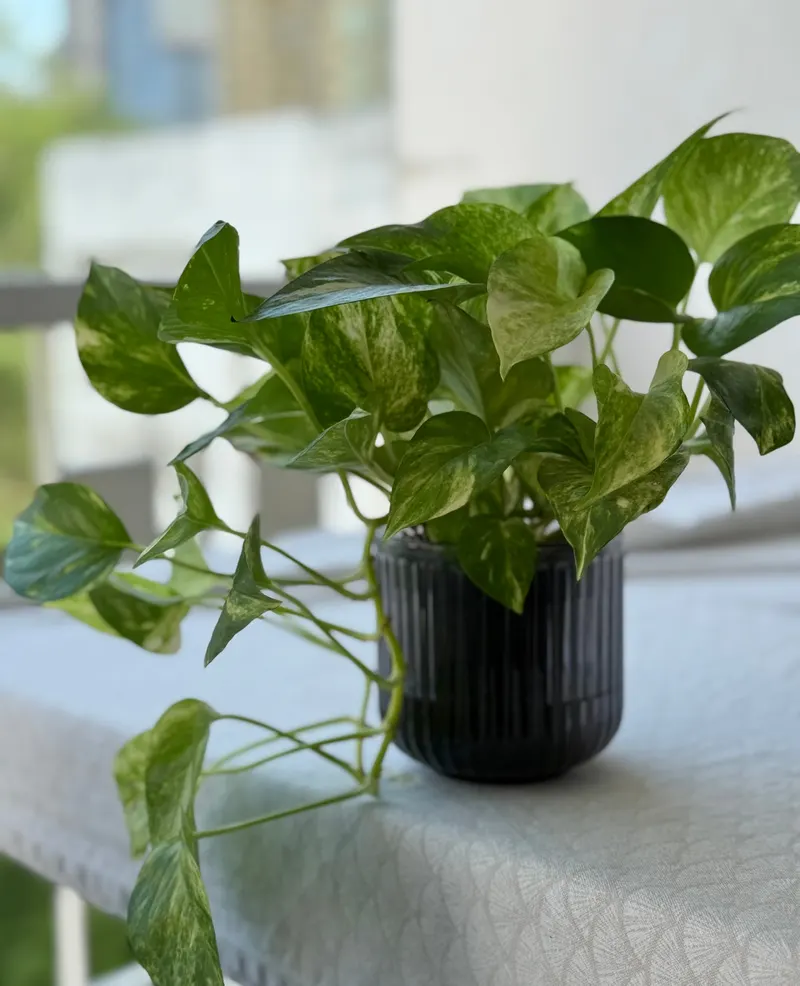
What it does for you
Pothos is considered easy to care for and adaptable1 – and it is one of the most popular houseplants in the world2. Its stems grow two metres and longer3. You can let it hang from a basket or climb a moss pole1. New plants are easy to raise in a glass of water1.
Origin & history
In the wild, pothos only grows on Mo'orea, one of the Society Islands in French Polynesia6.
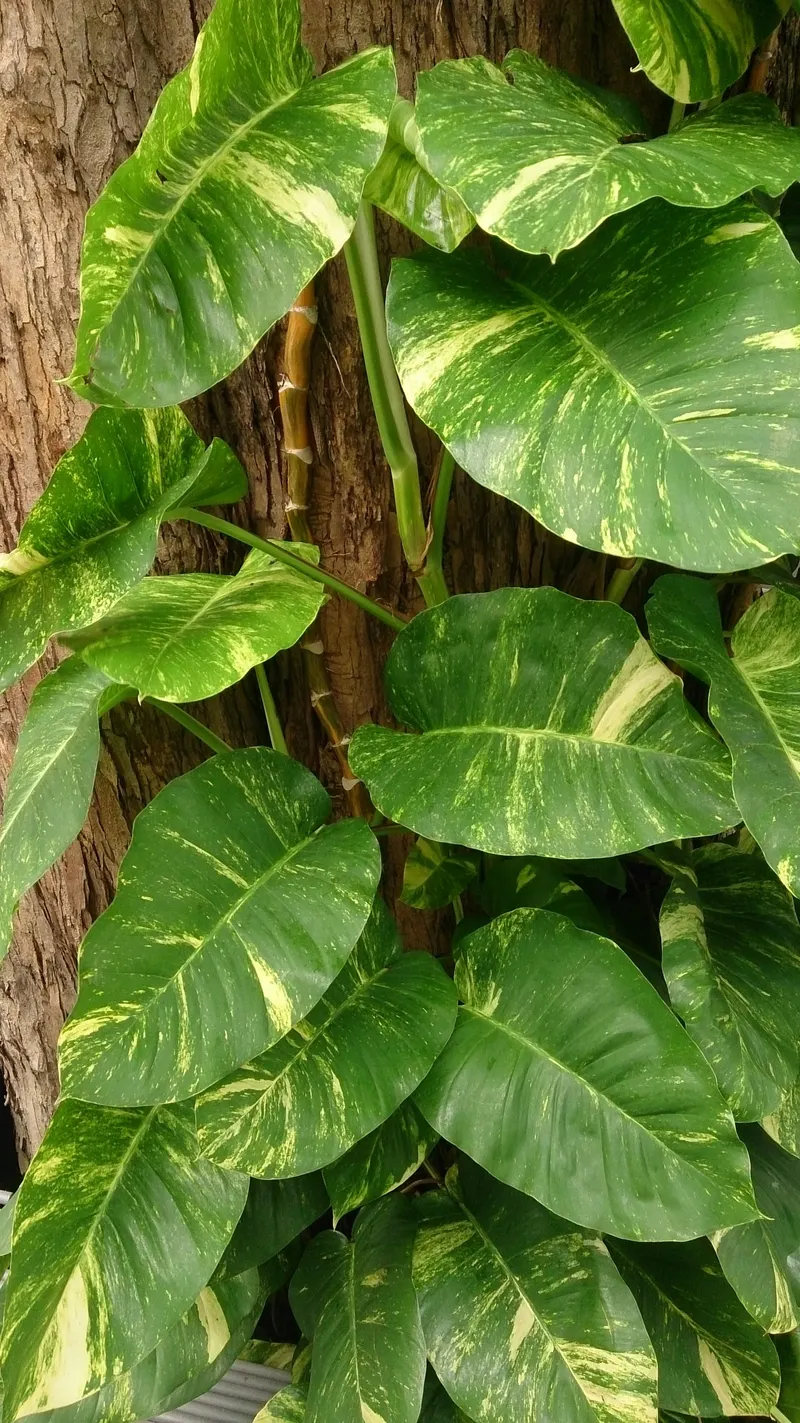
Its former botanical names were Scindapsus aureus and Pothos aureus6 – hence the name "pothos". By the way, the plant in your pot is a juvenile form: once it climbs upwards, its leaves grow many times larger2. You practically never see it flower – neither in the wild nor in cultivation. The last report of a flower dates from 1962. The reason is a lack of the plant hormone gibberellin – given gibberellin, it flowers2.
Caution
Pothos contains calcium oxalate crystals. Chewing on it irritates the mouth and throat and can cause vomiting and trouble swallowing7. In cats and dogs the mouth, tongue and lips burn intensely, they drool and vomit8. So: keep it out of reach of children and pets. It can irritate the skin – wear gloves when cutting1.
Care
Light. Bright without direct sun, e.g. at a window with morning or evening sun. Harsh summer sun scorches the leaves; with too little light it grows weakly and loses its pattern1.
Water. Only water once the soil is almost dry (finger test), and never leave it standing in water – otherwise the roots rot1. As a rule of thumb, that means about every one to two weeks in summer, less often in winter.
Temperature & humidity. 18–30 °C is ideal, no cold draughts1. Not below 16 °C at night7. It doesn't need high humidity1.
Soil, pot & repotting. Peat-free houseplant soil, a pot with a drainage hole. On a moss pole the stems hold on with aerial roots if you keep the pole moist1. Repot in spring when roots grow out of the pot – every two to three years, only one size bigger1.
Feeding. From spring to mid-autumn once a month with a general houseplant fertiliser1, not outside that season.
Extras
If it gets too long and bare, cut the stems back above a leaf – then it branches out and gets bushier1. The cut pieces are your next cuttings.

Symptoms & help
| too little | too much | |||
|---|---|---|---|---|
| Water | Leaves hang limp, the soil is dry all the way down. → Water thoroughly, pour off the excess after 15 minutes. | Yellow leaves, the soil stays wet, roots rot. → Let the soil dry out well, remove rotten roots, replant in fresh, free-draining soil. | ||
| Light | Weak growth, the marbling fades. → Move it somewhere brighter, cut back long stems. | Light brown, scorched patches on the leaves, especially in summer. → Move it out of direct sun. Scorched leaves stay patchy. | ||
| Fertiliser | Leaves turn yellow, new leaves stay small. → Feed once a month from spring to mid-autumn. | |||
| Warmth | Hardly grows any more, leaves suffer after cold draughts at the window or from vents. → Move it somewhere warmer, in winter away from cold windows, air conditioning and heating vents. |
Take it with you
- Plant cardFront and back in A6 landscape – print it and keep it next to the pot
- PDF ↓

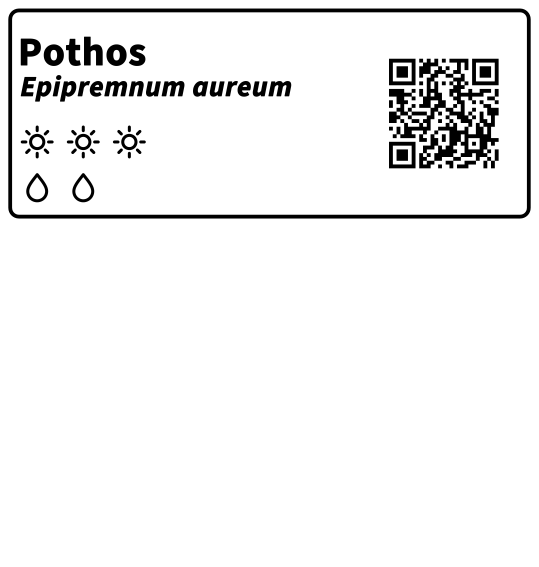
Notes on the files: Print & engrave
Licence and attribution for the plant labels: Readme (TXT)
Sources
- Royal Horticultural Society: How to grow epipremnum. RHS Growing Guides. https://www.rhs.org.uk/plants/epipremnum/growing-guide (accessed 11 October 2026)
- Hung, C.-Y., Qiu, J., Sun, Y.-H., Chen, J., Kittur, F. S., Henny, R. J., Jin, G., Fan, L. & Xie, J. (2016): Gibberellin deficiency is responsible for shy-flowering nature of Epipremnum aureum. Scientific Reports 6, 28598. doi:10.1038/srep28598
- Marquesen, S. (2025): Pothos as a Houseplant. Penn State Extension. https://extension.psu.edu/pothos-as-a-houseplant (accessed 12 October 2026)
- Wolverton, B. C., Johnson, A. & Bounds, K. (1989): Interior Landscape Plants for Indoor Air Pollution Abatement. NASA Technical Memorandum TM-101766. https://ntrs.nasa.gov/citations/19930073077
- Cummings, B. E. & Waring, M. S. (2020): Potted plants do not improve indoor air quality: a review and analysis of reported VOC removal efficiencies. Journal of Exposure Science & Environmental Epidemiology 30, 253–261. doi:10.1038/s41370-019-0175-9
- Royal Botanic Gardens, Kew: Epipremnum aureum (Linden & André) G.S.Bunting. Plants of the World Online. https://powo.science.kew.org/taxon/urn:lsid:ipni.org:names:87014-1 (accessed 11 October 2026)
- Taylor, A. & Tanner, C. (2026): How to Grow Pothos Indoors (Epipremnum spp.): Care, Cultivars, and Common Problems. Clemson Cooperative Extension, Home & Garden Information Center, HGIC 1568. https://hgic.clemson.edu/factsheet/how-to-grow-pothos-indoors-epipremnum-spp-care-cultivars-and-common-problems/ (accessed 11 October 2026)
- ASPCA Animal Poison Control Center: Golden Pothos (Epipremnum aureum). Toxic and Non-Toxic Plant List. https://www.aspca.org/pet-care/animal-poison-control/toxic-and-non-toxic-plants/golden-pothos (accessed 11 October 2026)
- Missouri Botanical Garden: Epipremnum aureum. Plant Finder. https://www.missouribotanicalgarden.org/PlantFinder/PlantFinderDetails.aspx?kempercode=b594 (accessed 12 October 2026)
- Royal Horticultural Society: Epipremnum aureum (golden pothos). RHS Plants. https://www.rhs.org.uk/plants/91403/epipremnum-aureum/details (accessed 12 October 2026)
- Berger, J., Essah, E. & Blanuša, T. (2024): The impact of plants on the humidity of naturally-ventilated office indoor environments. Journal of Building Engineering 86, 108814. doi:10.1016/j.jobe.2024.108814
- Royal Horticultural Society: How to take cuttings from houseplants. RHS Growing Guide. https://www.rhs.org.uk/plants/types/houseplants/how-to-take-cuttings-from-houseplants (accessed 14 October 2026)
- DelPrince, J. M. & Perry, J. H. (2021): Care & Selection of Indoor Plants. Mississippi State University Extension, Publication 1012. https://extension.msstate.edu/publications/care-selection-indoor-plants (accessed 11 October 2026)