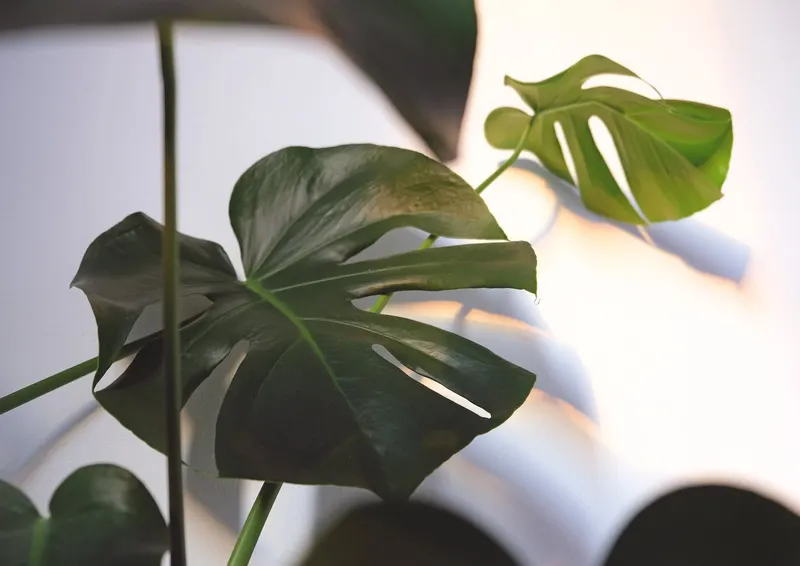
What it does for you
The monstera is a climbing plant from the rainforest, where it scrambles high up into the canopy. Its leaves grow up to 45 cm wide1. The holes only come with age: young plants have small, entire leaves1. And it's the only ornamental arum that is also grown for its fruit1.
Origin & history
According to POWO, the monstera grows wild in southern Mexico and in Guatemala3. Without support it creeps along the ground; with a tree it climbs nine metres and higher4.
It was already being grown in England in 17524. It used to be classed as a Philodendron1 – and is still sold as split-leaf or cutleaf philodendron5.
Caution
All parts except the flesh of the ripe fruit are toxic1. Even the ripe fruit irritates the throat in some people, and the floral remnants on it can irritate mouth and skin – if you try it, start with a small piece4. Chewing on it causes intense burning in the mouth, tongue and lips; cats and dogs drool, vomit and have trouble swallowing5. The sap irritates skin and eyes – wear gloves when cutting6.
Care
Light. Bright light; in winter direct sun is fine1. In summer, the RHS recommends bright, indirect light6; UConn gives 3–6 hours of direct sun a day7. With too little light, the leaves get no holes1. Get it used to more sun slowly, or the leaves burn7.
Water. Water when the top 5 cm (2 in) are dry7, then thoroughly; less in winter1. As a rule of thumb, about once a week in summer. Too much water makes the roots rot7.
Temperature & humidity. Warm room temperature. Below 10 °C it stops growing. Medium to high humidity – if the air is too dry, the leaf edges turn brown1.
Soil, pot & repotting. Rich, free-draining soil7. A moss pole kept moist gives the aerial roots support and water1. It often needs a new pot1 – but only once the roots reach the bottom and sides, and only one size bigger7.
Feeding. Once a month during the growing season6.
Extras
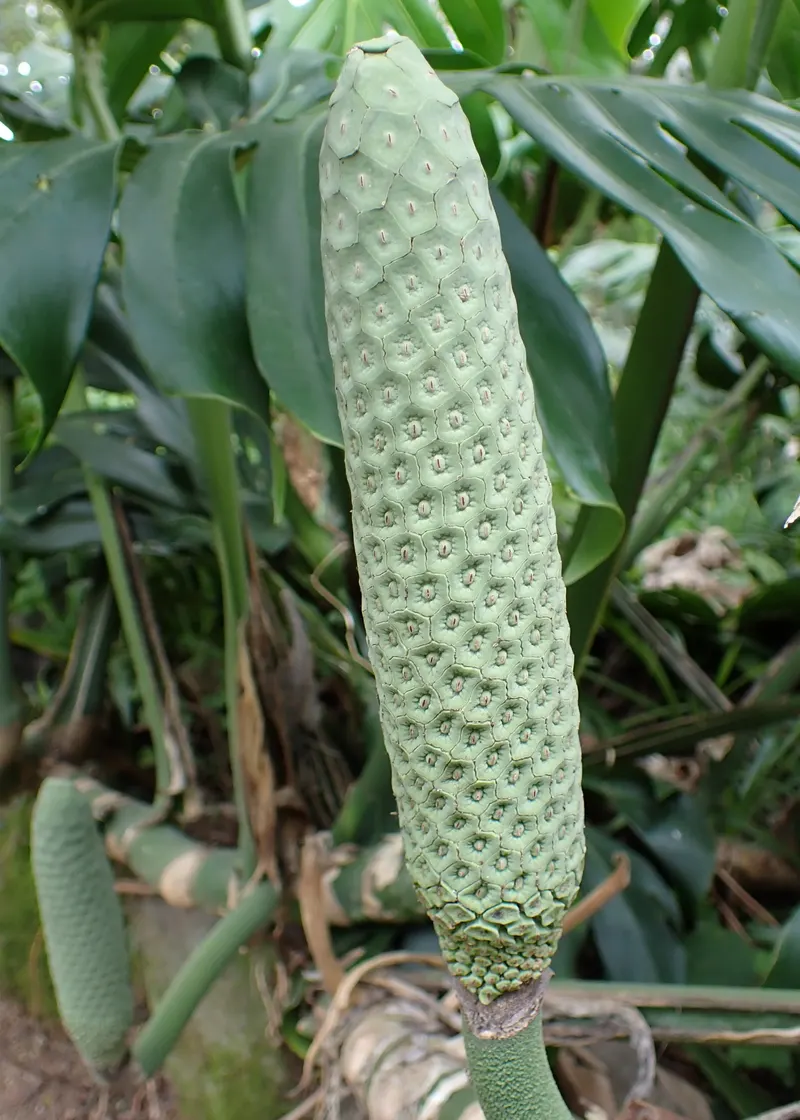
Indoor plants hardly ever flower1. From flower to ripe fruit takes 12 to 14 months. Ripe, the fruit tastes of pineapple and banana; unripe, it irritates the mouth and throat4.

Symptoms & help
| too little | too much | |||
|---|---|---|---|---|
| Water | Growth slows down, the leaf edges turn brown (dry air does that too). → Water thoroughly, then check more regularly. | Drops of water form on the leaf edges, the roots rot. → Water less, empty the cachepot, remove rotten roots and replant in fresh soil. | ||
| Light | New leaves get no holes. → Move it somewhere brighter, in winter happily with direct sun. | Burnt patches – often after a move into harsh sun or onto the balcony. → Get it used to the sun slowly, no harsh midday sun in summer. | ||
| Fertiliser | The plant grows slowly in the growing season. → Feed once a month from spring to early autumn. | Brown, burnt leaf edges – monstera is easily burned by salts in the soil. → Flush the soil thoroughly, don't feed for a few months. | ||
| Warmth | Stops growing, the leaves are damaged. → Move it somewhere warmer, not below 10 °C and away from cold windows. |
Take it with you
- Plant cardFront and back in A6 landscape – print it and keep it next to the pot
- PDF ↓


Notes on the files: Print & engrave
Licence and attribution for the plant labels: Readme (TXT)
Sources
- Mahr, S. (2026): Monstera deliciosa. University of Wisconsin–Madison Division of Extension, Wisconsin Horticulture. https://hort.extension.wisc.edu/articles/monstera-deliciosa/ (accessed 11 October 2026)
- Muir, C. D. (2013): How did the Swiss cheese plant get its holes? The American Naturalist 181(2), 273–281. doi:10.1086/668819
- Royal Botanic Gardens, Kew: Monstera deliciosa Liebm. Plants of the World Online. https://powo.science.kew.org/taxon/urn:lsid:ipni.org:names:87478-1 (accessed 11 October 2026)
- Morton, J. F. (1987): Ceriman. Fruits of Warm Climates, via Purdue University NewCROP. https://hort.purdue.edu/newcrop/morton/ceriman.html (accessed 11 October 2026)
- ASPCA Animal Poison Control Center: Cutleaf Philodendron (Monstera deliciosa). Toxic and Non-Toxic Plant List. https://www.aspca.org/pet-care/animal-poison-control/toxic-and-non-toxic-plants/cutleaf-philodendron (accessed 11 October 2026)
- Royal Horticultural Society: Monstera deliciosa (Swiss cheese plant). RHS Plants. https://www.rhs.org.uk/plants/11192/monstera-deliciosa/details (accessed 11 October 2026)
- UConn Home and Garden Education Center (2020): Monstera deliciosa. University of Connecticut, Fact Sheets. https://homegarden.cahnr.uconn.edu/factsheets/monstera-deliciosa (accessed 11 October 2026)
- NC State Extension: Monstera deliciosa. North Carolina Extension Gardener Plant Toolbox. https://plants.ces.ncsu.edu/plants/monstera-deliciosa/ (accessed 12 October 2026)
- Missouri Botanical Garden: Monstera deliciosa. Plant Finder. https://www.missouribotanicalgarden.org/PlantFinder/PlantFinderDetails.aspx?taxonid=276378 (accessed 12 October 2026)
- Berger, J., Essah, E. & Blanuša, T. (2024): The impact of plants on the humidity of naturally-ventilated office indoor environments. Journal of Building Engineering 86, 108814. doi:10.1016/j.jobe.2024.108814
- Royal Horticultural Society: How to take cuttings from houseplants. RHS Growing Guide. https://www.rhs.org.uk/plants/types/houseplants/how-to-take-cuttings-from-houseplants (accessed 14 October 2026)
- DelPrince, J. M. & Perry, J. H. (2021): Care & Selection of Indoor Plants. Mississippi State University Extension, Publication 1012. https://extension.msstate.edu/publications/care-selection-indoor-plants (accessed 11 October 2026)
- Royal Horticultural Society: Palms: indoors. RHS Advice. https://www.rhs.org.uk/plants/types/trees/indoor-palms (accessed 12 October 2026)