What it does for you
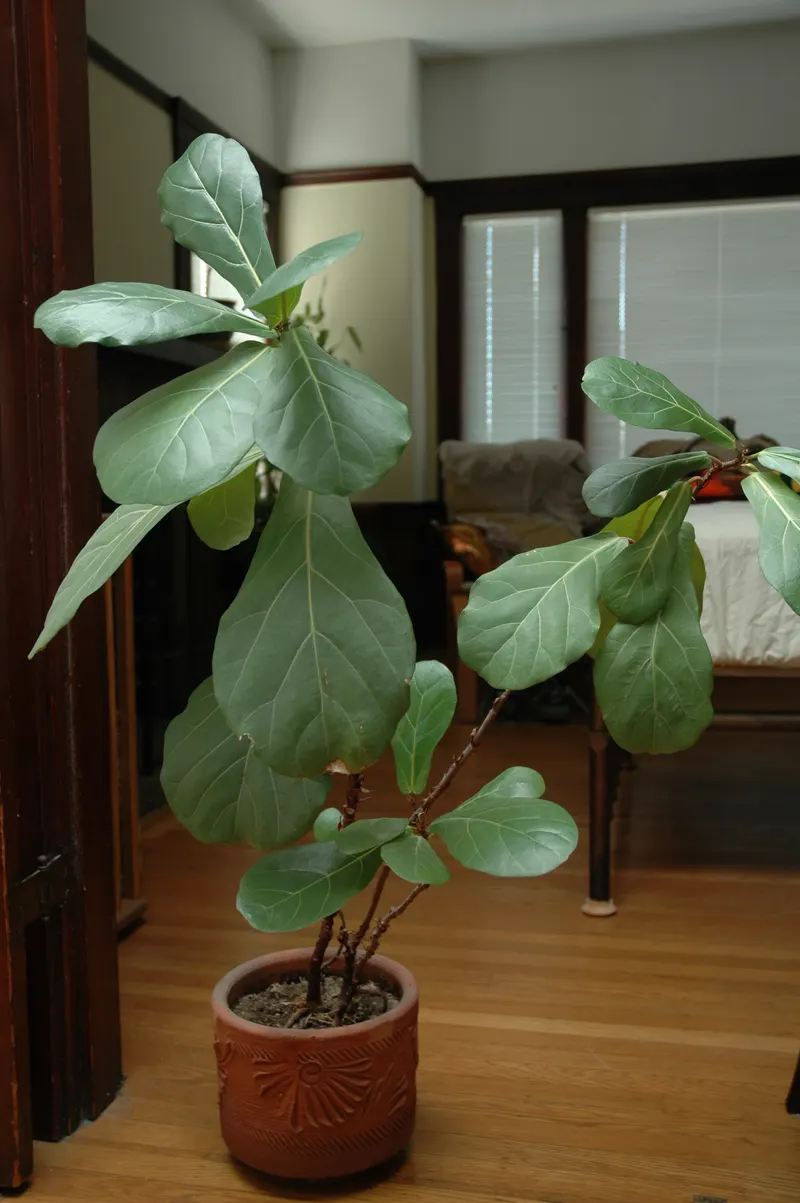
The fiddle-leaf fig has glossy, fiddle-shaped leaves up to 45 cm long1. Because it grows upright, it needs little floor space even as a stately tree2. Indoors it grows about 0.6 to 3 metres tall3.
Origin & history
In the wild, the fiddle-leaf fig grows in tropical West and Central Africa3, from Guinea-Bissau to Gabon5. There it's a tree of 18 to 30 metres3 that grows as a hemiepiphyte5.
It was only described scientifically in 18945. Its leaves resemble the body of a fiddle4 – it's also known as the banjo fig1.
Caution
All parts contain calcium oxalate. Chewing on it irritates the mouth, causes drooling and possibly vomiting; its toxicity is considered low3. For cats and dogs, the ASPCA lists irritation of the stomach, gut and skin for figs6. The sticky white sap can irritate the skin and make allergies worse – wear gloves when cutting2.
Care
Light. Very bright, ideally with morning sun7, but no harsh afternoon sun – or the leaves scorch3. If it's too dark, it grows long and thin, and the leaves turn dull or yellow7.
Water. Water when the top five centimetres are dry, and never leave it standing in water7. As a rule of thumb about once a week in summer. In winter keep the soil just slightly moist2.
Temperature & humidity. Evenly warm without big swings or draughts2, ideally 18–27 °C; below about 16 °C (60 °F) it risks chilling injury4. Medium humidity3; in dry air the leaf edges turn brown – keep it away from the radiator7, a tray of damp gravel helps2.
Soil, pot & repotting. Peat-free, loam-based compost with fine bark, or peat-free multi-purpose compost2. Every couple of years in spring into a slightly bigger pot; for large plants just replace the top 2.5 cm of soil2.
Feeding. From spring to late summer with a high-nitrogen fertiliser2. More isn't better: half strength is safer7 – as a rule of thumb about monthly.
Extras
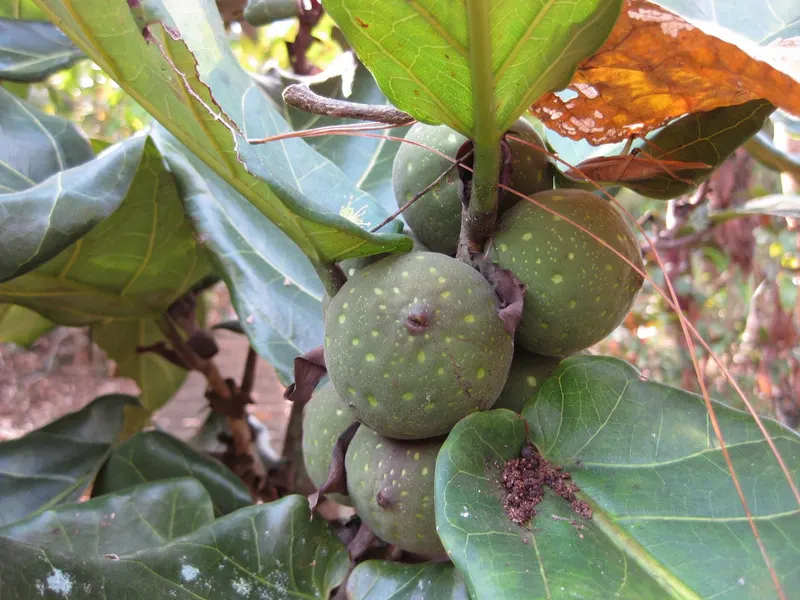
The large leaves collect dust – wipe them now and then with a damp cloth7. Flowers and the round figs, green with pale dots and red when ripe, rarely form indoors3.

Symptoms & help
| too little | too much | |||
|---|---|---|---|---|
| Water | Leaves turn yellow or dry up and drop. → Water thoroughly, then check the top few centimetres regularly. | Sudden leaf drop, yellow leaves or dark spots, rotting roots. → Water less often, empty the cachepot, let the soil dry out before watering again. | ||
| Light | Long, thin shoots, dull or yellow leaves, green leaves drop. → Move it somewhere brighter, ideally with morning sun – and then leave it there. | Brown, scorched patches on the leaves. → Protect it from afternoon sun; bright, but not in blazing sun. | ||
| Fertiliser | Brown, scorched leaf edges, leaves drop. → Don't feed for a while, then only at half strength. | |||
| Warmth | Brown spots, leaves drop – often in winter or in a draught. → Move it somewhere warmer and draught-free, not below 16 °C. |
Take it with you
- Plant cardFront and back in A6 landscape – print it and keep it next to the pot
- PDF ↓


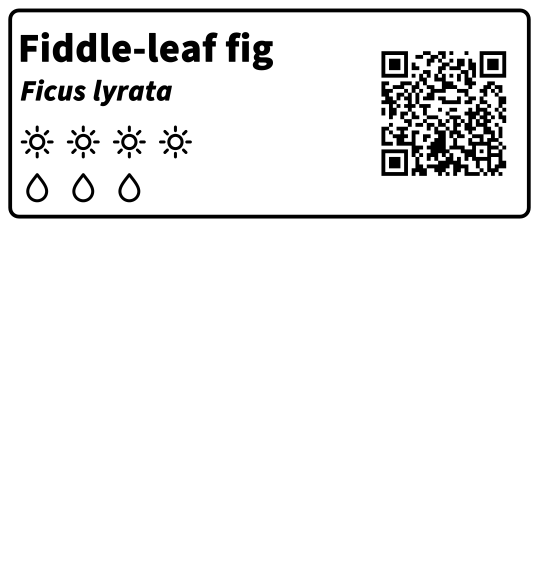
Notes on the files: Print & engrave
Licence and attribution for the plant labels: Readme (TXT)
Sources
- Royal Horticultural Society: Ficus lyrata. RHS Find a Plant. https://www.rhs.org.uk/plants/7207/ficus-lyrata/details (accessed 12 October 2026)
- Royal Horticultural Society: How to grow ornamental figs. RHS Growing Guides. https://www.rhs.org.uk/plants/popular/ornamental-figs/growing-guide (accessed 12 October 2026)
- North Carolina State University Extension: Ficus lyrata. North Carolina Extension Gardener Plant Toolbox. https://plants.ces.ncsu.edu/plants/ficus-lyrata/ (accessed 12 October 2026)
- Chen, J., McConnell, D. B., Henny, R. J. & Everitt, K. C. (2003): Cultural Guidelines for Commercial Production of Interiorscape Ficus. UF/IFAS Extension, ENH879/EP136. https://edis.ifas.ufl.edu/publication/EP136 (accessed 12 October 2026)
- Royal Botanic Gardens, Kew: Ficus lyrata Warb. Plants of the World Online. https://powo.science.kew.org/taxon/urn:lsid:ipni.org:names:853158-1 (accessed 12 October 2026)
- ASPCA Animal Poison Control Center: Fig (Ficus benjamina). Toxic and Non-Toxic Plant List. https://www.aspca.org/pet-care/animal-poison-control/toxic-and-non-toxic-plants/fig (accessed 12 October 2026)
- Phibbs, S. J. (2021): Fiddle Leaf Fig Houseplant – Proper Care. The Coastal Gardener, University of California Agriculture and Natural Resources. https://ucanr.edu/blog/coastal-gardener/article/fiddle-leaf-fig-houseplant-proper-care (accessed 12 October 2026)
- Missouri Botanical Garden: Ficus lyrata. Plant Finder. https://www.missouribotanicalgarden.org/PlantFinder/PlantFinderDetails.aspx?taxonid=282753 (accessed 12 October 2026)
- Berger, J., Essah, E. & Blanuša, T. (2024): The impact of plants on the humidity of naturally-ventilated office indoor environments. Journal of Building Engineering 86, 108814. doi:10.1016/j.jobe.2024.108814
- Royal Horticultural Society: How to take cuttings from houseplants. RHS Growing Guide. https://www.rhs.org.uk/plants/types/houseplants/how-to-take-cuttings-from-houseplants (accessed 14 October 2026)
- DelPrince, J. M. & Perry, J. H. (2021): Care & Selection of Indoor Plants. Mississippi State University Extension, Publication 1012. https://extension.msstate.edu/publications/care-selection-indoor-plants (accessed 11 October 2026)
- Royal Horticultural Society: Palms: indoors. RHS Advice. https://www.rhs.org.uk/plants/types/trees/indoor-palms (accessed 12 October 2026)