What it does for you
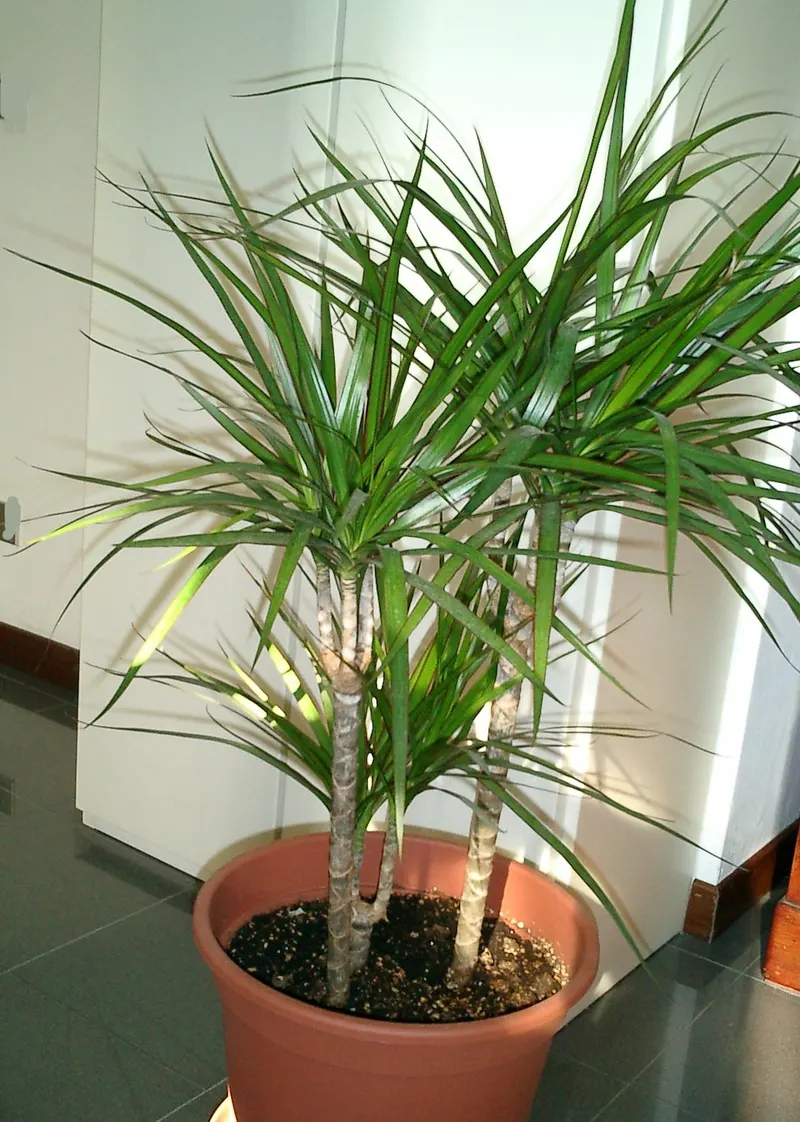
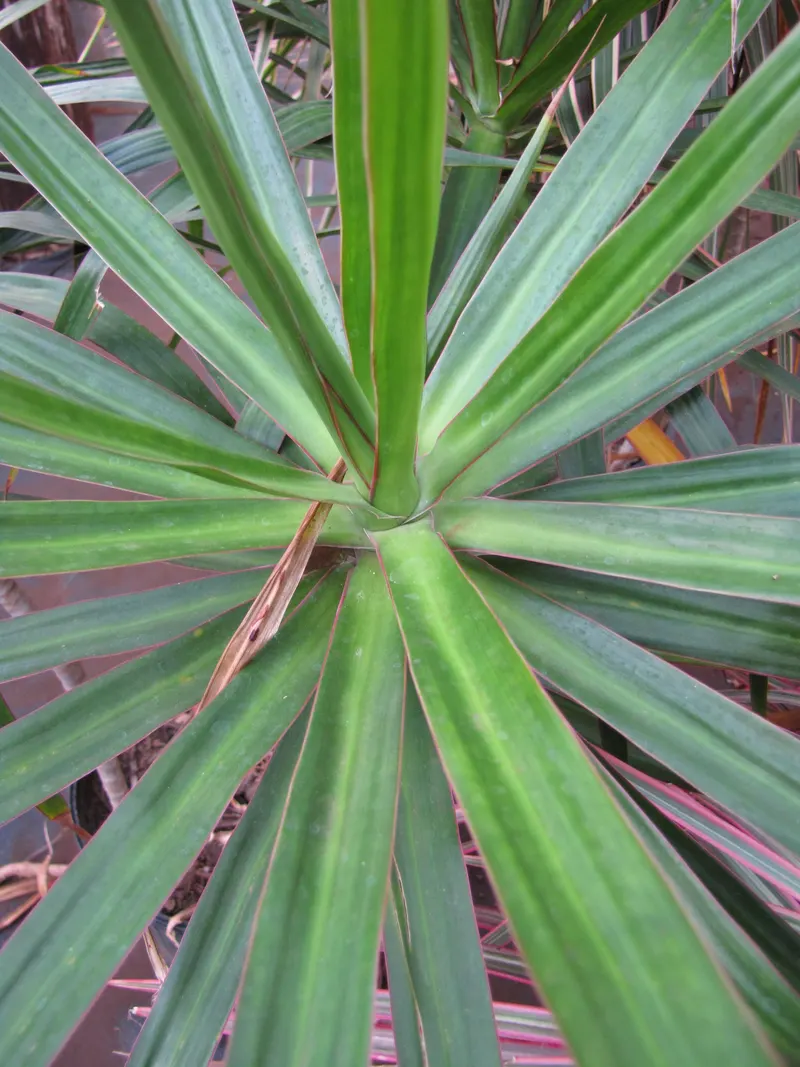
Several species are sold as dragon trees, such as Dracaena marginata and Dracaena fragrans1. This page is about D. marginata with its narrow, red-edged leaves. It's considered relatively undemanding, especially when it comes to light, and with its slender trunk it looks almost like a palm2. Because it copes with less light, it's often found in homes and offices3.
Origin & history
The Madagascar dragon tree grows as a shrub or small tree in the humid tropics of Madagascar and the islands of the western Indian Ocean – from Mauritius and Réunion to the Comoros and Seychelles6,7.
Its name is confusing: in the trade, D. marginata is used for different species2; its correct botanical name today is Dracaena reflexa var. angustifolia6,7. Since DNA analyses, the snake plant belongs to the dracaenas too8. The most famous relative is the true dragon tree (D. draco) of the Canary Islands, which grows up to 18 metres tall there2. Its red sap is called dragon's blood8 – such red resins were used as dye, varnish and medicine9.
Caution
All parts of the dracaena are toxic1. It contains saponins: if cats or dogs nibble on it, they may vomit, drool and lose their appetite, and in cats the pupils dilate10. For people it's considered mildly toxic; it can irritate the mouth and stomach, and sap on the skin can cause irritation7.
Care
Light. Bright, but without harsh sun – e.g. at a window with morning or evening sun; summer sun scorches the leaves1. It tolerates less light, but then the top turns towards the window – turn the pot now and then2.
Water. Only water once the top 5 cm are dry (finger test)1, then thoroughly and not with cold water3. As a very rough rule of thumb, that's about every one to two weeks in summer, less often in winter. Tip away water in the saucer2 – waterlogging makes the roots rot1. It's sensitive to fluoride7; rainwater or filtered water is kinder to the leaves1.
Temperature & humidity. It grows best at 18–30 °C1; a little cooler at night is fine, about 10–16 °C3. The RHS says it needs at least 18 °C for good growth and gets damaged below 5 °C; too close to the radiator the leaves turn brown8. As a safe margin, don't let it drop below 10 °C. It likes humid air1. If humidity drops below 30–40 % in winter, mist it now and then3.
Soil, pot & repotting. Free-draining, slightly acidic houseplant soil with some bark and only a little perlite1 – Clemson warns against a lot of it, because of the fluoride3. Use a pot with a drainage hole. Repot every two to three years in spring, into a pot only slightly bigger1.
Feeding. From spring to early autumn about once a month with liquid foliage plant fertiliser3,1. Too much fertiliser turns leaf tips and edges brown3.
Extras
Indoors it grows to just under two metres over the years – that takes a while, because it grows slowly7. Besides the green form there are colourful varieties such as 'Tricolor', 'Colorama' and 'Sunray'1.

Symptoms & help
| too little | too much | |||
|---|---|---|---|---|
| Water | Tips and edges turn brown and dry. → Water thoroughly, pour off the excess. Then check the top few centimetres regularly. | Leaves turn brown and die, the roots rot. → Let the soil dry out, don't leave water standing in the saucer and only water again once the top 5 cm are dry. | ||
| Light | The top leans towards the window. → Move it somewhere brighter and turn the pot regularly. | Brown, dry patches and tips. → Take it out of direct sun, especially in summer. | ||
| Fertiliser | Yellow or brown leaf tips and edges. → Don't feed for a while, then only about once a month in the growing season. | |||
| Warmth | Suddenly lots of leaves drop or the tips turn brown – often after cold draughts. → Move it somewhere warmer and draught-free, keep it away from cold windows in winter. |
Take it with you
- Plant cardFront and back in A6 landscape – print it and keep it next to the pot
- PDF ↓

Notes on the files: Print & engrave
Licence and attribution for the plant labels: Readme (TXT)
Sources
- Royal Horticultural Society: How to grow dracaena. RHS Growing Guides. https://www.rhs.org.uk/plants/dracaena/how-to-grow-dracaena (accessed 12 October 2026)
- Knickmann, B. (2013): Drachenbäume – Dracaena (Asparagaceae). Infoblatt, Botanischer Garten der Universität Wien. https://botanischergarten.univie.ac.at/fileadmin/user_upload/p_botanischergarten/Infoblaetter/Pflanzenlexikon/ib_dracaena_13.pdf (accessed 12 October 2026)
- Russ, K. & Pertuit, A. (1999): Dracaena. Clemson Cooperative Extension, Home & Garden Information Center, HGIC 1504. https://hgic.clemson.edu/factsheet/dracaena/ (accessed 12 October 2026)
- Wolverton, B. C., Johnson, A. & Bounds, K. (1989): Interior Landscape Plants for Indoor Air Pollution Abatement. NASA Technical Memorandum TM-101766. https://ntrs.nasa.gov/citations/19930073077
- Cummings, B. E. & Waring, M. S. (2020): Potted plants do not improve indoor air quality: a review and analysis of reported VOC removal efficiencies. Journal of Exposure Science & Environmental Epidemiology 30, 253–261. doi:10.1038/s41370-019-0175-9
- Royal Botanic Gardens, Kew: Dracaena reflexa var. angustifolia Baker. Plants of the World Online. https://powo.science.kew.org/taxon/urn:lsid:ipni.org:names:77189099-1 (accessed 12 October 2026)
- NC State Extension: Dracaena reflexa var. angustifolia. North Carolina Extension Gardener Plant Toolbox. https://plants.ces.ncsu.edu/plants/dracaena-reflexa-var-angustifolia/ (accessed 12 October 2026)
- Royal Horticultural Society: Dracaena. RHS Plants. https://www.rhs.org.uk/plants/dracaena (accessed 12 October 2026)
- Gupta, D., Bleakley, B. & Gupta, R. K. (2008): Dragon's blood: Botany, chemistry and therapeutic uses. Journal of Ethnopharmacology 115(3), 361–380. doi:10.1016/j.jep.2007.10.018
- ASPCA Animal Poison Control Center: Dracaena (Dracaena spp.). Toxic and Non-Toxic Plant List. https://www.aspca.org/pet-care/animal-poison-control/toxic-and-non-toxic-plants/dracaena (accessed 12 October 2026)
- Royal Horticultural Society: Dracaena marginata (v) (Madagascar dragon tree). RHS Plants. https://www.rhs.org.uk/plants/31916/dracaena-marginata-(v)/details (accessed 12 October 2026)
- Gubb, C., Blanusa, T., Griffiths, A. & Pfrang, C. (2018): Can houseplants improve indoor air quality by removing CO2 and increasing relative humidity? Air Quality, Atmosphere & Health 11, 1191–1201. doi:10.1007/s11869-018-0618-9
- Berger, J., Essah, E. & Blanuša, T. (2024): The impact of plants on the humidity of naturally-ventilated office indoor environments. Journal of Building Engineering 86, 108814. doi:10.1016/j.jobe.2024.108814
- Royal Horticultural Society: How to take cuttings from houseplants. RHS Growing Guide. https://www.rhs.org.uk/plants/types/houseplants/how-to-take-cuttings-from-houseplants (accessed 14 October 2026)
- DelPrince, J. M. & Perry, J. H. (2021): Care & Selection of Indoor Plants. Mississippi State University Extension, Publication 1012. https://extension.msstate.edu/publications/care-selection-indoor-plants (accessed 11 October 2026)
- Royal Horticultural Society: Palms: indoors. RHS Advice. https://www.rhs.org.uk/plants/types/trees/indoor-palms (accessed 12 October 2026)