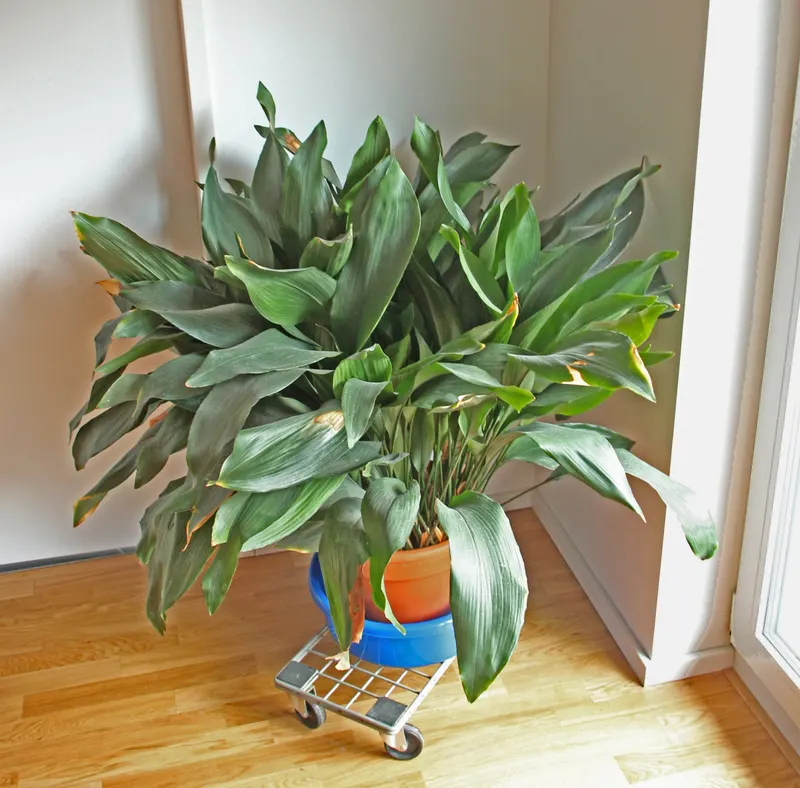
What it does for you
Aspidistras are among the easiest houseplants to grow: they cope with low light, erratic watering and changing temperatures, hence the name cast-iron plant1. That makes it a plant for a dark corner or a draughty hallway, and it can live for many years1. Its glossy, dark green, leathery leaves grow up to 60 cm long2,1.
Origin & history
In the wild it grows in southern Japan, mainly in the subtropics4; MBG also names China5, a Zurich database Taiwan and the southern Japanese islands6. It is the cast-iron or bar room plant of the Victorian era, and many dark Victorian homes were decorated with it7. Bar room plant refers to its ability to withstand spittoonish conditions8.
The genus name comes from the Greek aspidion, a shield5.
Caution
The ASPCA lists it as non-toxic for cats and dogs9; a University of Zurich veterinary database rates it as presumably non-toxic, having found no evidence of toxicity in the literature6. The Minnesota Poison Control System lists it as non-toxic for people, but notes that any plant may cause unexpected reactions in some people, including choking10.
Care
The RHS guide covers aspidistras in general; this species is the most widely sold.
Light. Ideally low or filtered light, well away from direct sun, which can scorch the leaves. In very poor light it grows more slowly, and variegated leaves may turn plain green1. MBG: best in bright indirect light; direct sun bleaches the leaves5.
Water. Water regularly from spring to autumn: moist, never waterlogged, as soggy compost can rot the roots. In winter a little less, but don't let it dry out completely1. As a rule of thumb, about once a week in summer.
Temperature & humidity. Happiest at 5–20 °C, in a fairly cool room away from heat sources; it copes with draughts and changing temperatures and is fine in the fairly dry air of normal homes1. MBG gives a winter minimum of 10 °C5.
Soil, pot & repotting. It grows slowly and can stay in its pot for several years, until roots appear through the drainage holes. Then repot in spring into a pot only slightly larger, in equal parts peat-free loam-based and peat-free multi-purpose compost1.
Feeding. A general-purpose houseplant feed monthly from spring to late summer1.
Extras
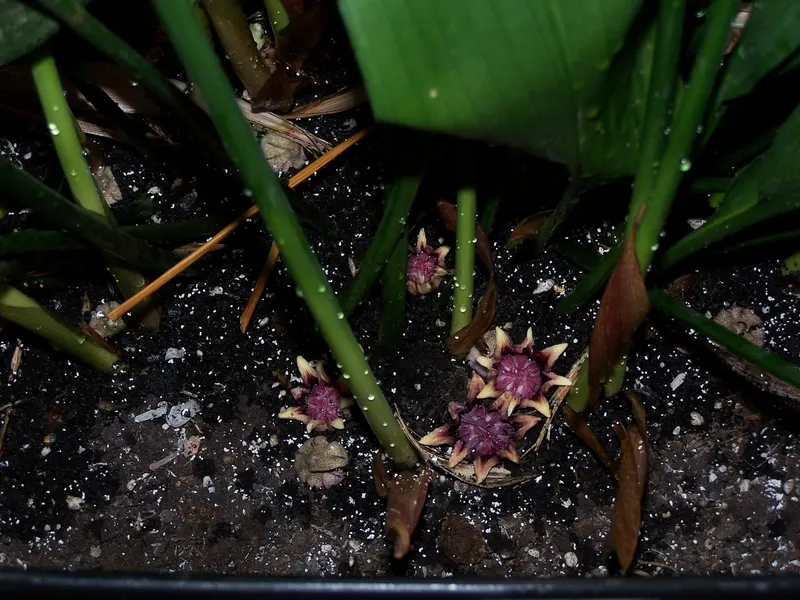
The inconspicuous flowers may appear at soil level, but usually not on houseplants5. Florists value the leaves11: in arrangements they last a month or longer7. 'Variegata' has leaves striped in creamy white1.

Symptoms & help
| too little | too much | |||
|---|---|---|---|---|
| Water | Leaves lean to the side and turn slightly pale green. → Water regularly from spring to autumn; in winter a little less, but never let it dry out completely. | The roots rot. → Water less – keep the compost moist, but never waterlogged. | ||
| Light | It grows more slowly; variegated leaves can turn plain green. → Move it to filtered light, still out of direct sun. | Leaves scorch, bleach or turn brown. → Move it well away from direct sun. |
Take it with you
- Plant cardFront and back in A6 landscape – print it and keep it next to the pot
- PDF ↓
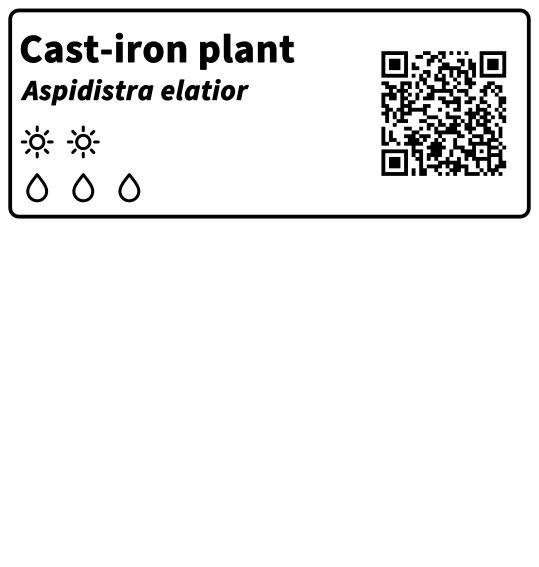
Notes on the files: Print & engrave
Licence and attribution for the plant labels: Readme (TXT)
Sources
- Royal Horticultural Society: How to grow aspidistras. RHS Growing Guide. https://www.rhs.org.uk/plants/aspidistra/how-to-grow-aspidistras (accessed 21 October 2026)
- Royal Horticultural Society: Aspidistra elatior. RHS Find a Plant. https://www.rhs.org.uk/plants/1715/aspidistra-elatior/details (accessed 21 October 2026)
- Cummings, B. E. & Waring, M. S. (2020): Potted plants do not improve indoor air quality: a review and analysis of reported VOC removal efficiencies. Journal of Exposure Science & Environmental Epidemiology 30, 253–261. doi:10.1038/s41370-019-0175-9
- Royal Botanic Gardens, Kew: Aspidistra elatior Blume. Plants of the World Online. https://powo.science.kew.org/taxon/urn:lsid:ipni.org:names:531586-1 (accessed 21 October 2026)
- Missouri Botanical Garden: Aspidistra elatior. Plant Finder. https://www.missouribotanicalgarden.org/PlantFinder/PlantFinderDetails.aspx?kempercode=b579 (accessed 21 October 2026)
- Institut für Veterinärpharmakologie und -toxikologie, Universität Zürich: Aspidistra elatior. Arznei- und Giftpflanzen (CliniTox). https://www.vetpharm.uzh.ch/giftdb/pflanzen/0345_bot.htm (accessed 21 October 2026)
- Stamps, R. H. (2003): Aspidistra Production and Use. University of Florida IFAS Extension, ENH890. https://ufdcimages.uflib.ufl.edu/UF/00/08/93/74/00001/EP14700.pdf (accessed 21 October 2026)
- North Carolina State Extension: Aspidistra elatior. North Carolina Extension Gardener Plant Toolbox. https://plants.ces.ncsu.edu/plants/aspidistra-elatior/ (accessed 21 October 2026)
- ASPCA Animal Poison Control Center: Cast Iron Plant (Aspidistra elatior). Toxic and Non-Toxic Plant List. https://www.aspca.org/pet-care/animal-poison-control/toxic-and-non-toxic-plants/cast-iron-plant (accessed 21 October 2026)
- Minnesota Poison Control System: Plant Guide List. Minnesota Poison Control System. https://mnpoison.org/wp-content/uploads/plant-guide-list.pdf (accessed 21 October 2026)
- DelPrince, J. M. (2025): Aspidistra (Aspidistra elatior) for the Farmer Florist. Mississippi State University Extension, Publication 4138. https://extension.msstate.edu/sites/default/files/document/2025-11/P4138_web.pdf (accessed 21 October 2026)
- Berger, J., Essah, E. & Blanuša, T. (2024): The impact of plants on the humidity of naturally-ventilated office indoor environments. Journal of Building Engineering 86, 108814. doi:10.1016/j.jobe.2024.108814
- Royal Horticultural Society: How to take cuttings from houseplants. RHS Growing Guide. https://www.rhs.org.uk/plants/types/houseplants/how-to-take-cuttings-from-houseplants (accessed 14 October 2026)
- DelPrince, J. M. & Perry, J. H. (2021): Care & Selection of Indoor Plants. Mississippi State University Extension, Publication 1012. https://extension.msstate.edu/publications/care-selection-indoor-plants (accessed 11 October 2026)