What it does for you
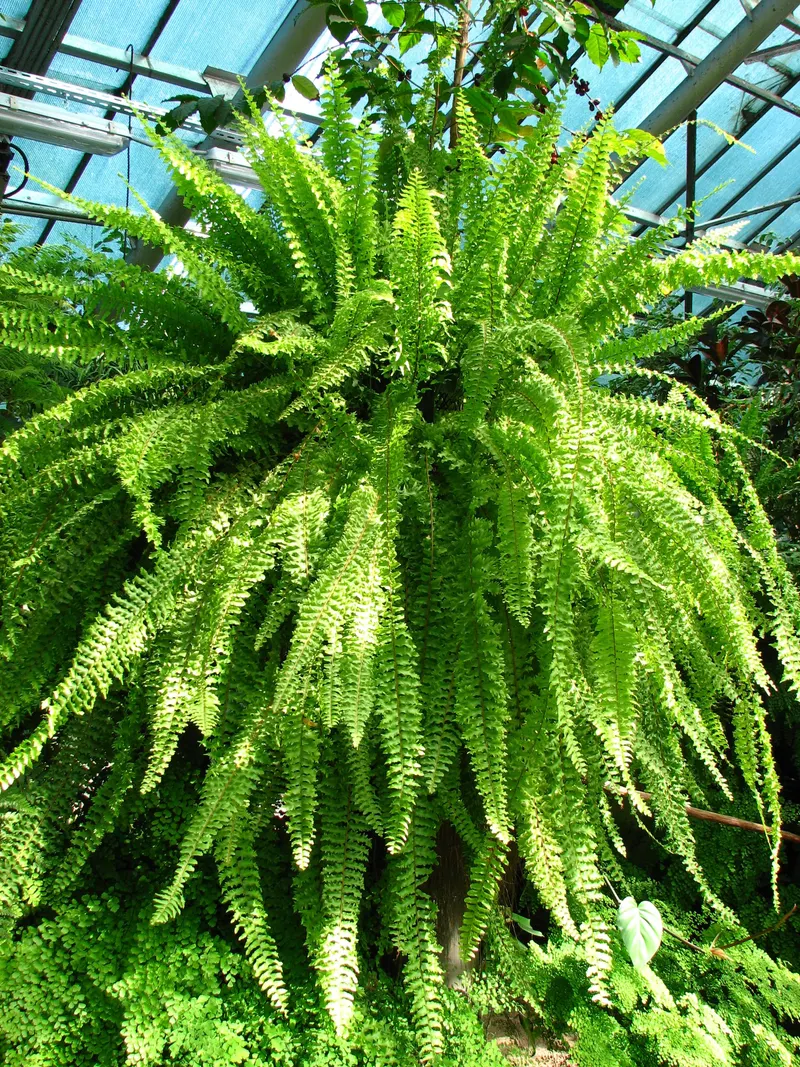
The Boston fern is a classic: this variety of the sword fern, 'Bostoniensis', has long been a popular houseplant1. Its fronds grow up to 90 centimetres long, arch and hang over on all sides2 – perfect for hanging baskets, pedestals and plant stands3. On top of that, it's non-toxic for people, cats and dogs4,5.
Origin & history
The sword fern grows wild in tropical and subtropical America – from Florida, Texas and the Caribbean islands through Central America to Bolivia and Brazil, and also on Hawaii8. There it grows up to two metres tall3.
The Boston fern is a natural mutant with arching fronds. It was noticed in the mid-1890s in Boston, in a shipment of ferns from Philadelphia3,9 – hence the name.
Caution
The sword fern is not toxic for cats and dogs4, and no poisonings in humans are known either5. It's still not a snack.
Care
Light. Bright, but without direct sun – e.g. at a window with morning sun or behind a net curtain3. A spot close to a shady window works too; it never belongs right at a window with midday or afternoon sun2.
Water. Always keep the soil slightly moist, but not wet2. Ideally use soft water, and water a little more sparingly in winter10. If it dries out, it drops fronds1. Still, of all the common ferns it forgives dryness best3.
Temperature & humidity. About 20 °C during the day, a few degrees cooler at night is welcome, but not below 10 °C2. It needs high humidity – otherwise the tips turn brown3. A tray of wet gravel helps, as does a spot in the bathroom or kitchen1.
Soil, pot & repotting. Peat-free multipurpose compost10, porous and quick to drain2. Repot every few years in spring3.
Feeding. From spring to early autumn once a month at half strength2. Too much fertiliser turns the frond tips brown3.
Extras
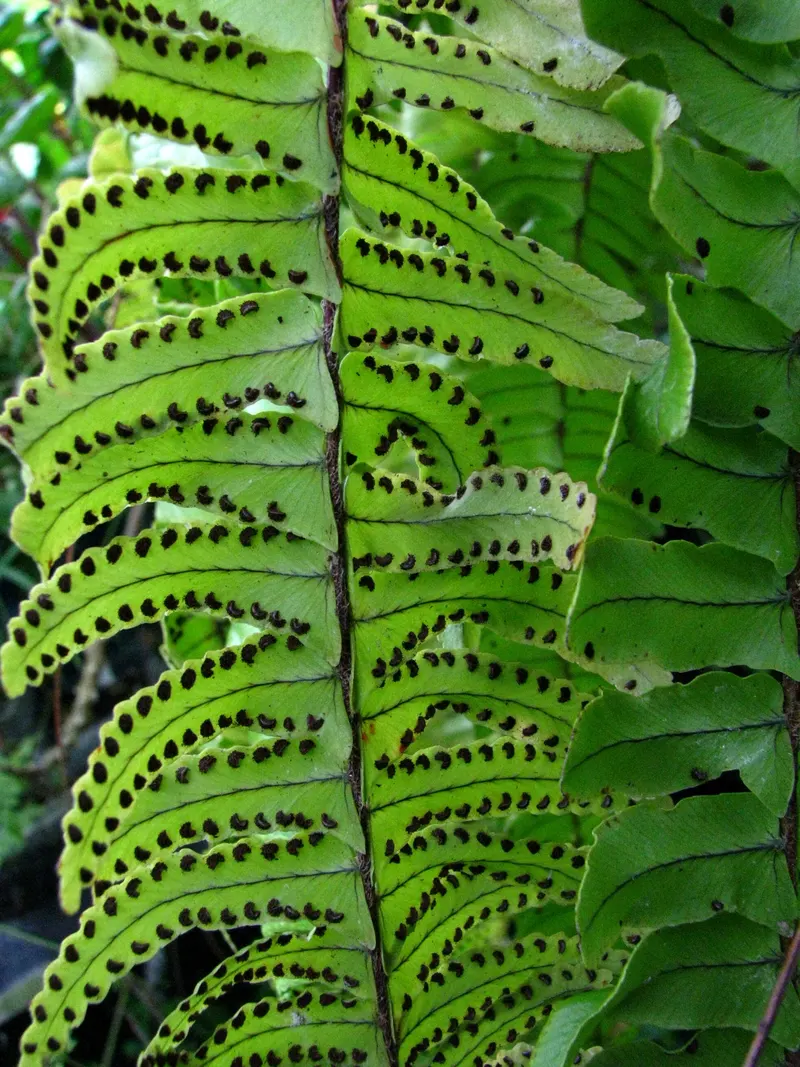
The sword fern often produces new forms. That's how many varieties came about, such as 'Fluffy Ruffles' with upright, ruffled fronds or the small 'Dallas', which gets by with less light and humidity3. By the way, the name Nephrolepis means "kidney scale"1.

Symptoms & help
| too little | too much | |||
|---|---|---|---|---|
| Water | Fronds drop, the plant turns grayish and grows slowly. → Water until the soil is evenly moist again, pour off the excess. Cut dried-up fronds off near the soil – new ones grow back. | Fronds and roots rot, the soil stays wet. → Water less until the soil is just moist, not wet. Cut off rotten fronds, water more sparingly in winter. | ||
| Light | Fronds grow long, weak and drooping, and there are fewer of them. → Move it somewhere brighter, e.g. to a shady window or one with morning sun. | Fronds turn pale or light green, and scorch in direct sun. → Move it out of direct sun, cut scorched fronds off near the soil. | ||
| Fertiliser | Fronds turn brown and dry from the tips. → Flush the soil thoroughly, afterwards feed only at half strength. | |||
| Warmth | Fronds are damaged by cold nights at the window or on the balcony – it is frost-tender. → Move it somewhere warmer, not below 10 °C. Cut damaged fronds off near the soil. |
Take it with you
- Plant cardFront and back in A6 landscape – print it and keep it next to the pot
- PDF ↓

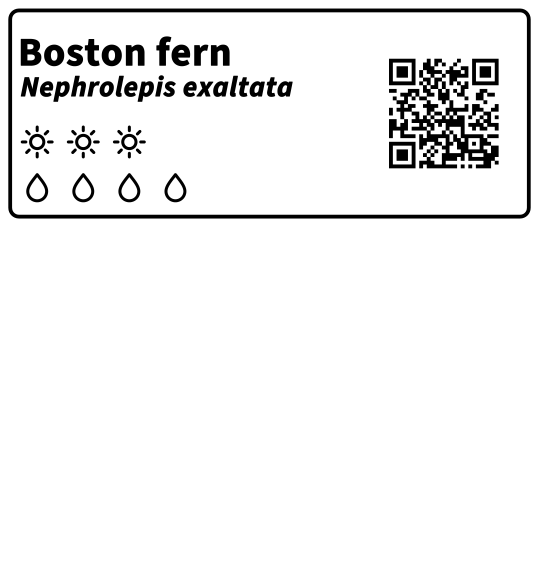
Notes on the files: Print & engrave
Licence and attribution for the plant labels: Readme (TXT)
Sources
- Missouri Botanical Garden: Nephrolepis exaltata. Plant Finder. https://www.missouribotanicalgarden.org/PlantFinder/PlantFinderDetails.aspx?kempercode=c548 (accessed 12 October 2026)
- Russ, K. & Pertuit, A. (rev. Smith, B. H.) (2015): Indoor Ferns. Clemson Cooperative Extension, Home & Garden Information Center, HGIC 1505. https://hgic.clemson.edu/factsheet/indoor-ferns/ (accessed 12 October 2026)
- Mahr, S. (2025): Boston Fern, Nephrolepis exaltata var. Bostoniensis. University of Wisconsin–Madison Division of Extension, Wisconsin Horticulture. https://hort.extension.wisc.edu/articles/boston-fern-nephrolepis-exaltata-bostoniensis/ (accessed 12 October 2026)
- ASPCA Animal Poison Control Center: Boston Fern (Nephrolepis exalta bostoniensis). Toxic and Non-Toxic Plant List. https://www.aspca.org/pet-care/animal-poison-control/toxic-and-non-toxic-plants/boston-fern (accessed 12 October 2026)
- University of Nebraska–Lincoln Extension in Lancaster County (2015): Toxicity of Common Houseplants. Horticulture fact sheet 031 (archived copy). https://web.archive.org/web/20241123081117/https://lancaster.unl.edu/hort/factsheets/031_toxicityhouseplants.pdf (accessed 12 October 2026)
- Kim, K. J., Jeong, M. I., Lee, D. W., Song, J. S., Kim, H. D., Yoo, E. H., Jeong, S. J., Han, S. W., Kays, S. J., Lim, Y.-W. & Kim, H.-H. (2010): Variation in Formaldehyde Removal Efficiency among Indoor Plant Species. HortScience 45(10), 1489–1495. doi:10.21273/HORTSCI.45.10.1489
- Cummings, B. E. & Waring, M. S. (2020): Potted plants do not improve indoor air quality: a review and analysis of reported VOC removal efficiencies. Journal of Exposure Science & Environmental Epidemiology 30, 253–261. doi:10.1038/s41370-019-0175-9
- Royal Botanic Gardens, Kew: Nephrolepis exaltata (L.) Schott. Plants of the World Online. https://powo.science.kew.org/taxon/urn:lsid:ipni.org:names:17160830-1 (accessed 12 October 2026)
- Schall, B., Huo, H. & Chen, J.: Cultural Guidelines for Commercial Production of Boston Fern (Nephrolepis exaltata 'Bostoniensis'). UF/IFAS Extension, EDIS publication EP550. https://ask.ifas.ufl.edu/publication/EP550 (accessed 12 October 2026)
- Royal Horticultural Society: Nephrolepis exaltata 'Bostoniensis' (sword fern 'Bostoniensis'). RHS Plants. https://www.rhs.org.uk/plants/58296/nephrolepis-exaltata-bostoniensis/details (accessed 12 October 2026)
- NC State Extension: Nephrolepis exaltata. North Carolina Extension Gardener Plant Toolbox. https://plants.ces.ncsu.edu/plants/nephrolepis-exaltata/ (accessed 12 October 2026)
- Berger, J., Essah, E. & Blanuša, T. (2024): The impact of plants on the humidity of naturally-ventilated office indoor environments. Journal of Building Engineering 86, 108814. doi:10.1016/j.jobe.2024.108814