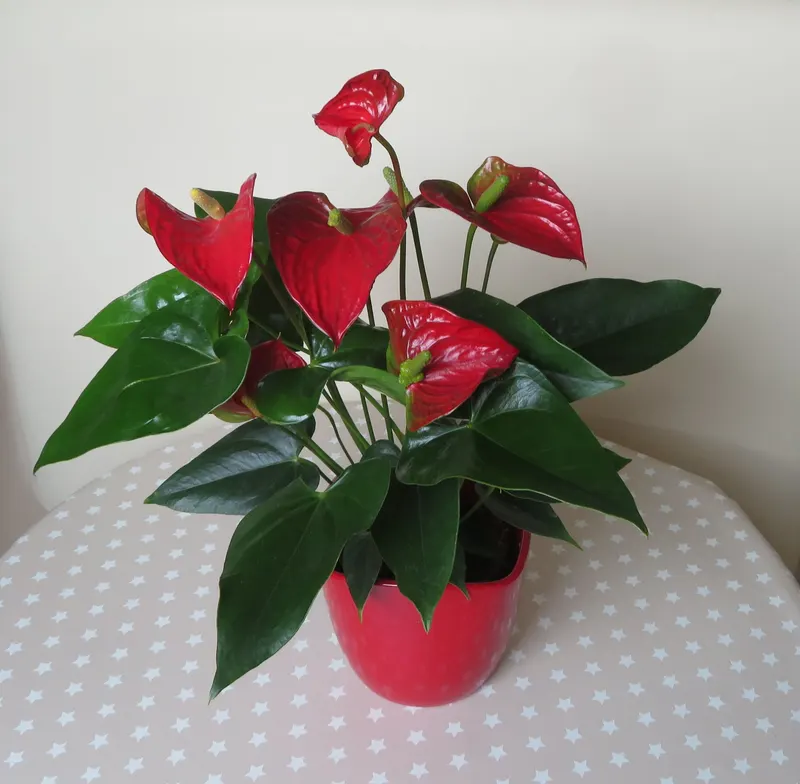
What it does for you
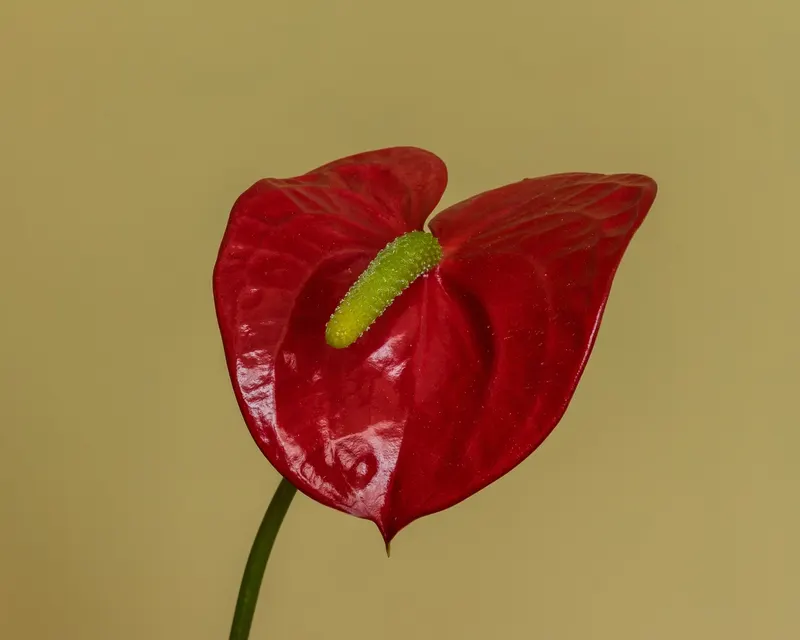
The anthurium flowers all year round, and each flower head (inflorescence) lasts several weeks1. In a commercial growing guide, several cultivars kept flowering for over a year and a half under indoor light2. On top of that come dark green leaves with an arrow-shaped base3 – a lovely sight even without flowers.
Origin & history
Anthurium andraeanum grows wild in Colombia and Ecuador5 – as a vine-like epiphyte in humid forests at 400 to 1200 metres4. It was discovered in 1876 in south-western Colombia; the French botanist Édouard André sent it to Jean Linden's nursery in Belgium4.
The anthuriums in shops are mostly interspecific hybrids of A. andraeanum with related species – that's the group this page is about. Leading producers include the Netherlands, Hawaii, Mauritius and Jamaica, both of pot plants and of cut flowers4.
Caution
All parts contain calcium oxalate crystals. Chewing on them causes pain and swelling of the mouth, lips and tongue, heavy drooling and difficulty swallowing6. Cats and dogs show the same symptoms and vomit, according to the ASPCA's entry for the related Anthurium scherzeranum7. The sap irritates skin and eyes – wear gloves when cutting3.
Care
Light. Bright without direct sun, e.g. at a window with morning or evening sun or behind a net curtain at a sunny window; harsh sun scorches the leaves1. If it's too dark, it makes lots of leaves but hardly any flowers2.
Water. Water when the soil is almost dry five centimetres down – ideally with rainwater or filtered water at room temperature. Too much water makes the roots rot1. Water more sparingly in winter3. As a rule of thumb, that means about once a week in summer.
Temperature & humidity. 18–30 °C all year, away from radiators and cold draughts1. Below 13 °C it gets damaged2. If the air is too dry, the leaves turn brown – a tray of damp gravel or neighbouring plants help1.
Soil, pot & repotting. Acidic and free-draining: two parts peat-free ericaceous compost, one part each of perlite and orchid bark. Repot every two to three years into a pot only slightly bigger1.
Feeding. From spring to mid-autumn regularly with orchid fertiliser1, about every two weeks3. Too much fertiliser turns the lower leaves yellow with brown tips2.
Extras
Over 600 cultivars are available today, with bracts in red, pink, orange, coral, white, green, purple or brown, some two-coloured4. Simply cut spent flower stalks and old leaves off at the base1.

Symptoms & help
| too little | too much | |||
|---|---|---|---|---|
| Water | Leaf tips burn brown, the roots get damaged, growth slows. → Water thoroughly and more often. Check the soil more often from now on. | Older leaves turn yellow, the soil stays wet, the roots rot. → Water less often, empty the cachepot, remove yellow leaves. If the roots are damaged, repot in fresh, well-draining soil. | ||
| Light | Lots of new leaves, but few or no flowers. → Move it somewhere brighter, e.g. to a window with morning or evening sun – but out of harsh sun. | Leaves bleach in the middle, the tips turn brown. → Move it out of direct sun or draw a net curtain. | ||
| Fertiliser | Flowers only sparsely despite a bright spot. → From spring to mid-autumn add orchid fertiliser to the water every two weeks. | Lower leaves turn yellow with brown tips, salts build up in the soil. → Flush the soil thoroughly, then feed less. | ||
| Warmth | Stops growing, after cold nights the leaves get damaged. → Move it somewhere warmer, above 18 °C, away from the cold window and out of draughts. |
Take it with you
- Plant cardFront and back in A6 landscape – print it and keep it next to the pot
- PDF ↓

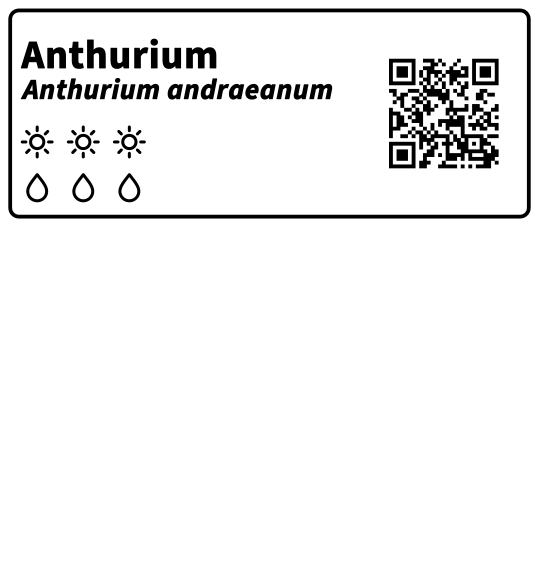
Notes on the files: Print & engrave
Licence and attribution for the plant labels: Readme (TXT)
Sources
- Royal Horticultural Society: How to grow anthuriums. RHS Growing Guides. https://www.rhs.org.uk/plants/anthuriums/how-to-grow-anthuriums (accessed 12 October 2026)
- Chen, J., McConnell, D. B., Henny, R. J. & Everitt, K. C. (2003): Cultural Guidelines for Commercial Production of Interiorscape Anthurium. UF/IFAS Extension, ENH956/EP159 (revised 2015). https://edis.ifas.ufl.edu/publication/EP159 (accessed 12 October 2026)
- Royal Horticultural Society: Anthurium andraeanum. RHS Find a Plant. https://www.rhs.org.uk/plants/1349/anthurium-andraeanum/details (accessed 12 October 2026)
- Liu, Y., Cai, T., Su, Q., Yi, M., Xia, Q., Yuan, Y., Zeng, R., Xie, L., Guo, H., Zhang, Z., Zhou, X. & Wei, Q. (2025): The origin, germplasm resources, and breeding of Anthurium andraeanum: an overview. Ornamental Plant Research 5, e003. doi:10.48130/opr-0025-0002
- Royal Botanic Gardens, Kew: Anthurium andraeanum Linden ex André. Plants of the World Online. https://powo.science.kew.org/taxon/urn:lsid:ipni.org:names:84549-1 (accessed 12 October 2026)
- NC State Extension: Anthurium andraeanum. North Carolina Extension Gardener Plant Toolbox. https://plants.ces.ncsu.edu/plants/anthurium-andraeanum/ (accessed 12 October 2026)
- ASPCA Animal Poison Control Center: Flamingo Flower (Anthurium scherzeranum). Toxic and Non-Toxic Plant List. https://www.aspca.org/pet-care/animal-poison-control/toxic-and-non-toxic-plants/flamingo-flower (accessed 12 October 2026)
- Berger, J., Essah, E. & Blanuša, T. (2024): The impact of plants on the humidity of naturally-ventilated office indoor environments. Journal of Building Engineering 86, 108814. doi:10.1016/j.jobe.2024.108814
- Royal Horticultural Society: How to take cuttings from houseplants. RHS Growing Guide. https://www.rhs.org.uk/plants/types/houseplants/how-to-take-cuttings-from-houseplants (accessed 14 October 2026)
- DelPrince, J. M. & Perry, J. H. (2021): Care & Selection of Indoor Plants. Mississippi State University Extension, Publication 1012. https://extension.msstate.edu/publications/care-selection-indoor-plants (accessed 11 October 2026)