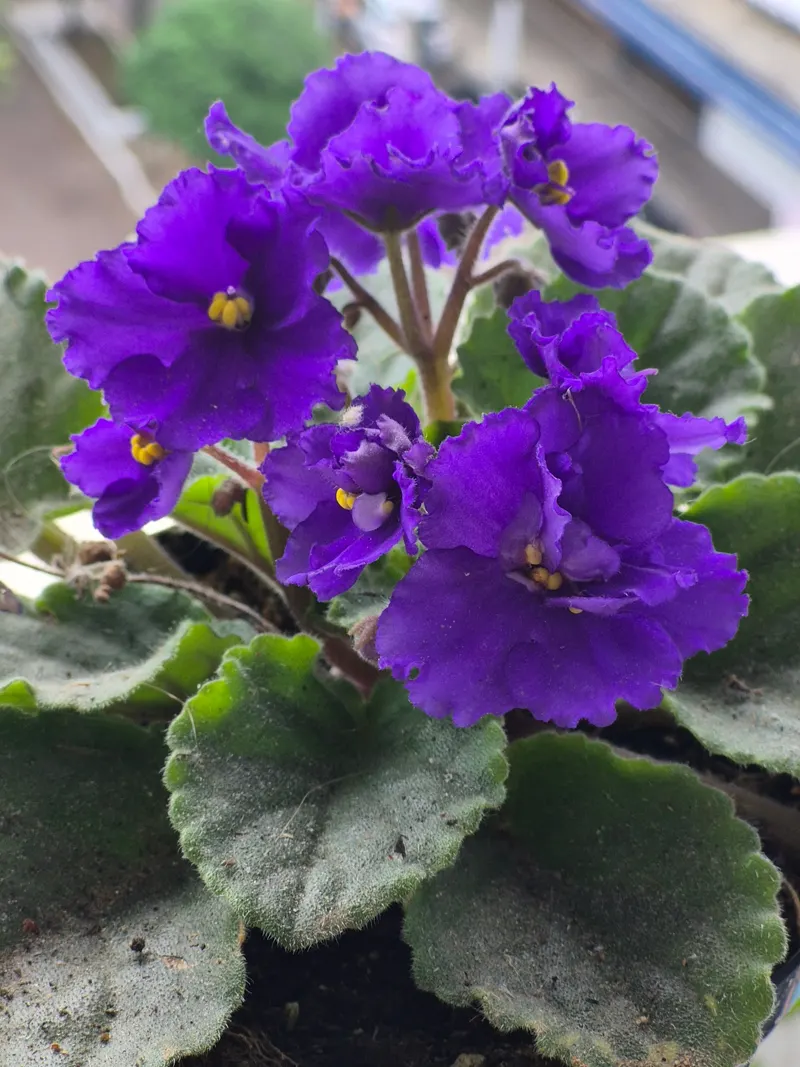
What it does for you
Given the right conditions, the African violet can flower non-stop for months on end1 – in proper conditions, Clemson says, even year-round2. Being compact, it fits even where indoor space is limited1. The ASPCA lists it as non-toxic for cats and dogs3. It doesn't measurably clean the air: depending on the study, you'd need ten to a thousand plants per square metre4.
Origin & history
The wild species grows in Kenya and Tanzania, on rocks7; as houseplants, thousands of cultivars are grown8. In 1893 Hermann Wendland named the genus Saintpaulia after Baron Walter von Saint Paul-Illaire, who collected plants in 1891 and sent them to his father in Germany, and after the father9.
POWO now lists it as Streptocarpus ionanthus7, but the old name is still widely used1. Where forest is cleared, the habitats of wild African violets dry out and their populations die10.
Caution
The ASPCA lists it as non-toxic for cats and dogs3. The Bonn poison centre rates it as non-toxic for people too; larger amounts can still cause stomach upset and nausea11.
Care
Light. Lots of bright light, but no direct sun, especially in summer – it scorches the leaves; too little light reduces or halts flowering. From spring to autumn a north- or east-facing window (south- or east-facing in the southern hemisphere), in winter a south- or west-facing one (north- or west-facing in the southern hemisphere)1.
Water. Room-temperature water once the surface is dry, onto the compost or from below for half an hour. Wetting the plant can lead to mould or rot1; cold water on the leaves can cause white blotches2. As a rule of thumb, about once a week.
Temperature & humidity. 18–24 °C by day and 16 °C at night, all year, without cold draughts or sudden changes1. After nights below about 16 °C it is stunted and can take long to recover8. It dislikes dry air: stand it on damp gravel, but don't mist – that marks the leaves1.
Soil, pot & repotting. Light, free-draining, peat-free houseplant or African violet compost. Every two to three years in spring, slightly larger: too large or deep a pot can deter flowering. Usually about 10 cm is the maximum1.
Feeding. For more flowers, you can give a dilute liquid feed every three to four weeks in spring and summer1. Yellowing lower leaves and slower growth usually mean it needs fertiliser2.
Extras
Cultivars range from micro-miniatures 3–6 cm across to large standards over 75 cm12.
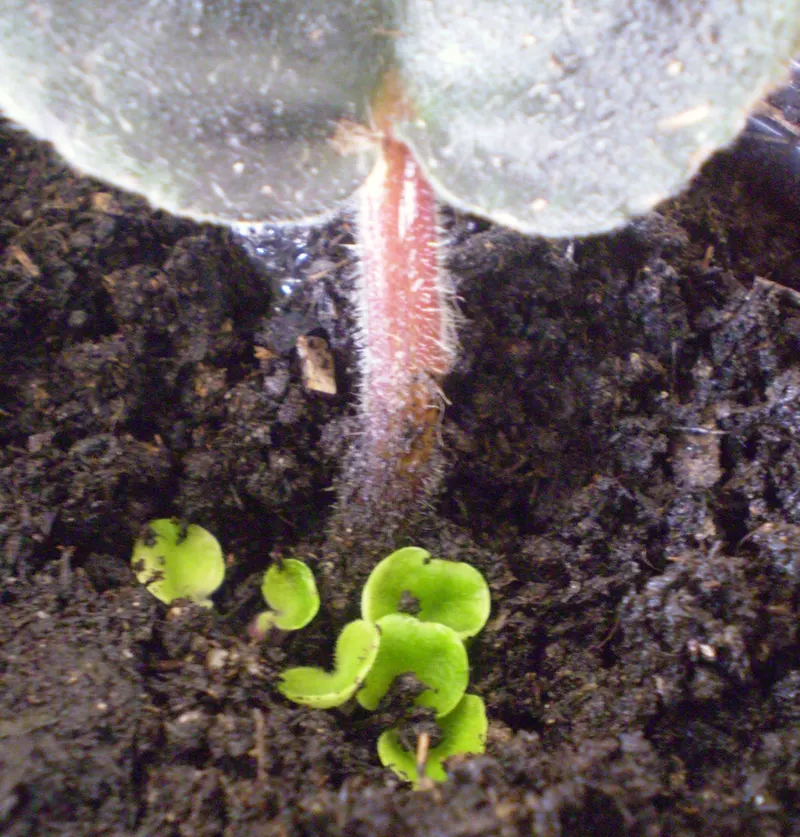

Symptoms & help
| too little | too much | |||
|---|---|---|---|---|
| Water | Few or no flowers. → Water as soon as the surface is dry, with water at room temperature. | Crown and roots rot. → Let the surface dry before watering, and never leave it standing in damp soil. | ||
| Light | Thin, dark green leaves on long stalks; few or no flowers. → Move it somewhere brighter, but out of direct sun. In winter, a sunnier window. | Scorched leaves. → Move it out of direct sun or behind a thin curtain. | ||
| Fertiliser | Older, lower leaves turn yellow; it grows more slowly. → Feed every 3–4 weeks in spring and summer. | |||
| Warmth | Stunted after nights below about 16 °C; recovery can take long. → Keep it at 16 °C or more at night, away from cold draughts. |
Take it with you
- Plant cardFront and back in A6 landscape – print it and keep it next to the pot
- PDF ↓

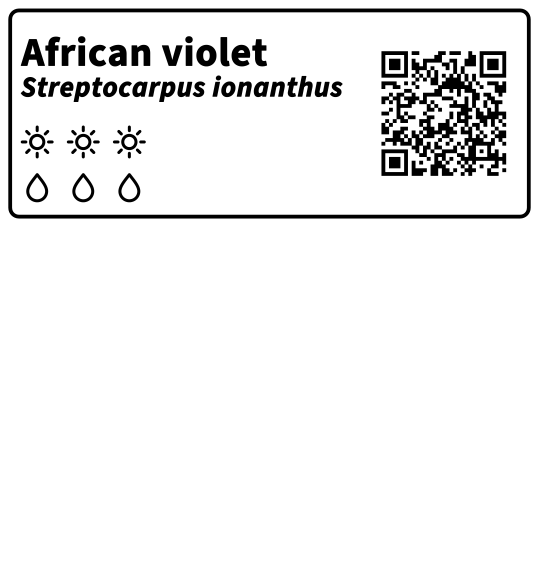
Notes on the files: Print & engrave
Licence and attribution for the plant labels: Readme (TXT)
Sources
- Royal Horticultural Society: How to grow African violets. RHS Growing Guide. https://www.rhs.org.uk/plants/african-violets/growing-guide (accessed 20 October 2026)
- Doubrava, N. & Polomski, R. F. (1999): African Violet. Clemson Cooperative Extension, Home & Garden Information Center, HGIC 1550. https://hgic.clemson.edu/factsheet/african-violet/ (accessed 20 October 2026)
- ASPCA Animal Poison Control Center: African Violet (Saintpaulia spp.). Toxic and Non-Toxic Plant List. https://www.aspca.org/pet-care/aspca-poison-control/toxic-and-non-toxic-plants/african-violet (accessed 20 October 2026)
- Cummings, B. E. & Waring, M. S. (2020): Potted plants do not improve indoor air quality: a review and analysis of reported VOC removal efficiencies. Journal of Exposure Science & Environmental Epidemiology 30, 253–261. doi:10.1038/s41370-019-0175-9
- The Gesneriad Society: African Violets in Cultivation. Gesneriad Reference Web – Saintpaulia. https://gesneriads.info/articles/saintpaulia/saintpaulia/history-in-cultivation/ (accessed 20 October 2026)
- The Gesneriad Society: African Violets: Why So Popular? Gesneriad Reference Web – Saintpaulia. https://gesneriads.info/articles/saintpaulia/saintpaulia/history-in-cultivation/african-violets-popular/ (accessed 20 October 2026)
- Royal Botanic Gardens, Kew: Streptocarpus ionanthus (H.Wendl.) Christenh. Plants of the World Online. https://powo.science.kew.org/taxon/urn:lsid:ipni.org:names:77117375-1 (accessed 20 October 2026)
- North Carolina State Extension: Streptocarpus ionanthus. North Carolina Extension Gardener Plant Toolbox. https://plants.ces.ncsu.edu/plants/streptocarpus-ionanthus/ (accessed 20 October 2026)
- The Gesneriad Society: Early Discovery and Naming. Gesneriad Reference Web – Saintpaulia. https://gesneriads.info/articles/saintpaulia/saintpaulia/taxonomy/early-discovery-naming/ (accessed 20 October 2026)
- The Gesneriad Society: Conservation. Gesneriad Reference Web – Saintpaulia. https://gesneriads.info/articles/saintpaulia/saintpaulia/conservation/ (accessed 20 October 2026)
- Informationszentrale gegen Vergiftungen Bonn: Usambaraveilchen. Giftzentrale Bonn – Pflanzen. https://gizbonn.de/giftzentrale-bonn/pflanzen/usambaraveilchen (accessed 20 October 2026)
- The Gesneriad Society: African Violets: Variety is Beautiful! Gesneriad Reference Web – Saintpaulia. https://gesneriads.info/articles/saintpaulia/saintpaulia/history-in-cultivation/variety-is-beautiful/ (accessed 20 October 2026)
- Berger, J., Essah, E. & Blanuša, T. (2024): The impact of plants on the humidity of naturally-ventilated office indoor environments. Journal of Building Engineering 86, 108814. doi:10.1016/j.jobe.2024.108814
- Royal Horticultural Society: How to take cuttings from houseplants. RHS Growing Guide. https://www.rhs.org.uk/plants/types/houseplants/how-to-take-cuttings-from-houseplants (accessed 14 October 2026)